
GreenCode maps a codebase, generates the tests and documentation it lacks, automates remediation and load testing, and returns reviewable pull requests, so teams spend less time on scaffolding and more on features.
Most engineering time goes not on new code but on understanding existing code, working out what a change will break, writing tests that should already exist and reviewing changes nobody documented. The code analysis review describes the starting point: systems spanning millions of lines built over many years, documentation that is incomplete or outdated, and source code as the only reliable reference. The same review puts 60 to 80 percent of all software in the legacy category.
The intended result is plain: increasing the useful lifetime and maintainability of a codebase boosts developer productivity and decreases time to market for new features. The state of the art review lists a general-purpose replacement for IDE copilots as a non-priority. GreenCode instead removes the overhead around development: comprehension, artefact generation, testing, benchmarking and review.
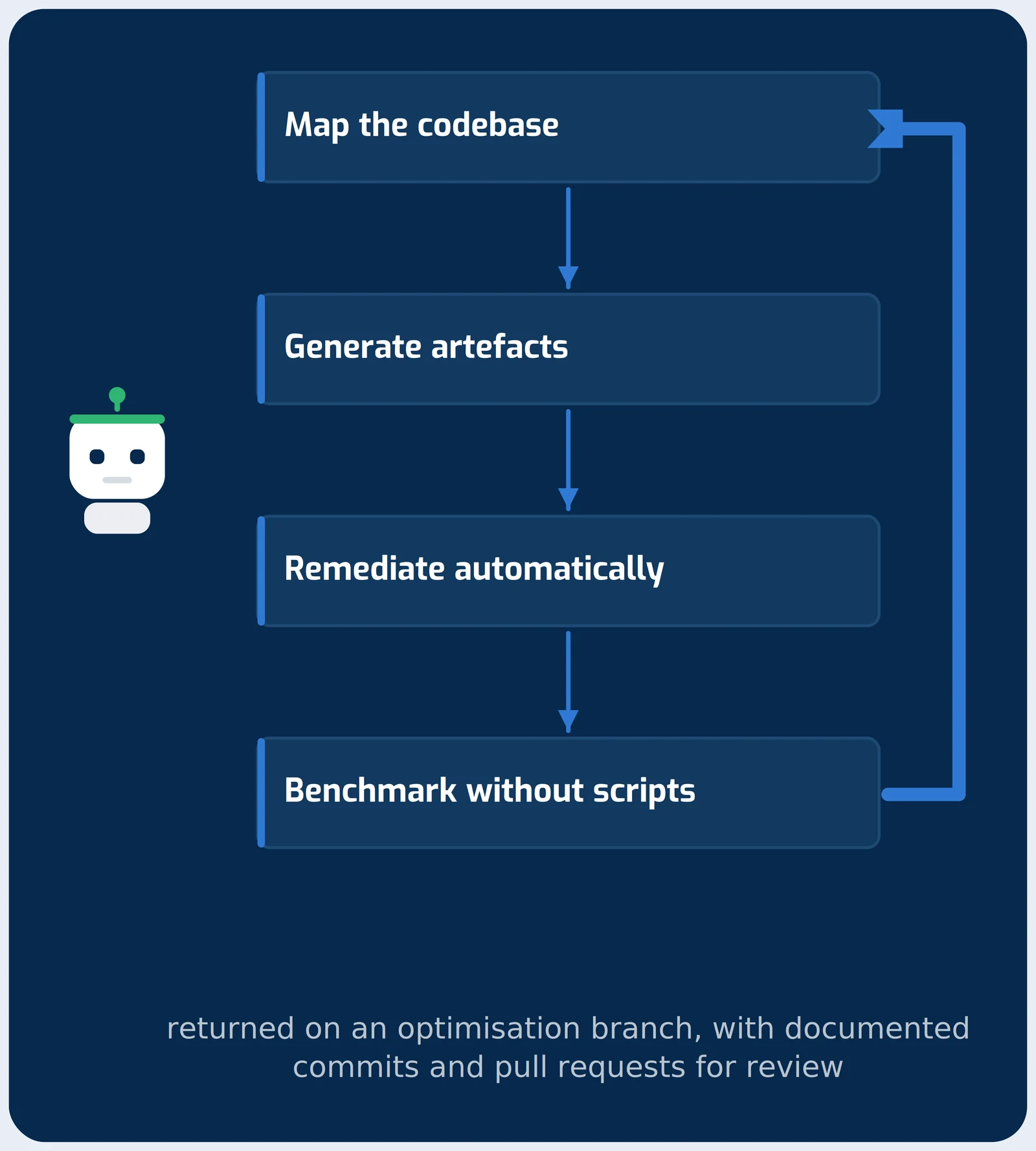
Four pipeline stages take work off the development team. The pipeline first maps the codebase, indexing it line by line into a searchable, updateable index with a software bill of materials in SPDX format, and identifying interfaces and endpoints. Developers get a current picture of the system without reading it end to end.
 View full size
Next it generates artefacts. Where unit tests, in-code documentation or external documentation are missing, GenAI creates them. The state of the art review reports empirical studies that found LLM-generated documentation on a par with human-written documentation for readability, relevance and completeness, and that generated tests slot into standard frameworks such as JUnit, pytest and Jest.
Then it remediates automatically. Static analysis findings against ISO/IEC SQuaRE, OWASP and GSF green software patterns become machine-readable action lists. AI refactoring works through them, generating documentation, unit tests and commit messages as it goes and flagging deficient dependencies from the bill of materials.
Finally it benchmarks without hand-written scripts. Once APIs and endpoints are indexed and unit tests exist, the pipeline uses GenAI to derive load tests in a standard format for the benchmarking stage, so performance and energy hotspots can be located without manual test writing.
The output is an optimisation branch with documented commits and pull requests, so developers review instead of rewrite.
The state of the art review is direct about the risks. Copilot-style tools have led to siloed, developer-centric practices that create new forms of AI-induced technical debt at team level. Single-pass generation is often outperformed by iterative, workflow-based approaches that combine translation, test generation, error correction and call-graph analysis. Current benchmarks such as HumanEval and MBPP ignore energy, so tools can appear successful while producing inefficient code.
GreenCode takes the iterative route, with measurement and regression checks between steps, and its requirements include QASER, a combined count of quality issues, security flaws and error rate that must not rise during optimisation.
The code analysis work package delivers the codebase mapping toolkit and the GenAI artefact generator for documentation and unit tests. The AI work package develops porting tools for VB6 to C# that migrate forms, classes, modules and controls and automate syntax conversion, API mapping and refactoring to reduce manual effort. They are applied to a large industrial plant engineering system in the pipeline trials, and the industrial partners expect to use the pipeline to improve the productivity and velocity of legacy migrations.
End-to-end trials on legacy codebases ask whether live micro-tests during active development or bulk processing at the end of a tranche of work delivers more value per unit of energy.
Partner use cases define the measures. A banking and insurance mainframe use case tracks the percentage increase in developer productivity as a KPI. An automotive driver-assistance platform measures time to onboard and test case development rate. A WordPress use case names the lack of documentation and code artefacts, which makes iteration and debugging complex and costly, as an issue to fix.
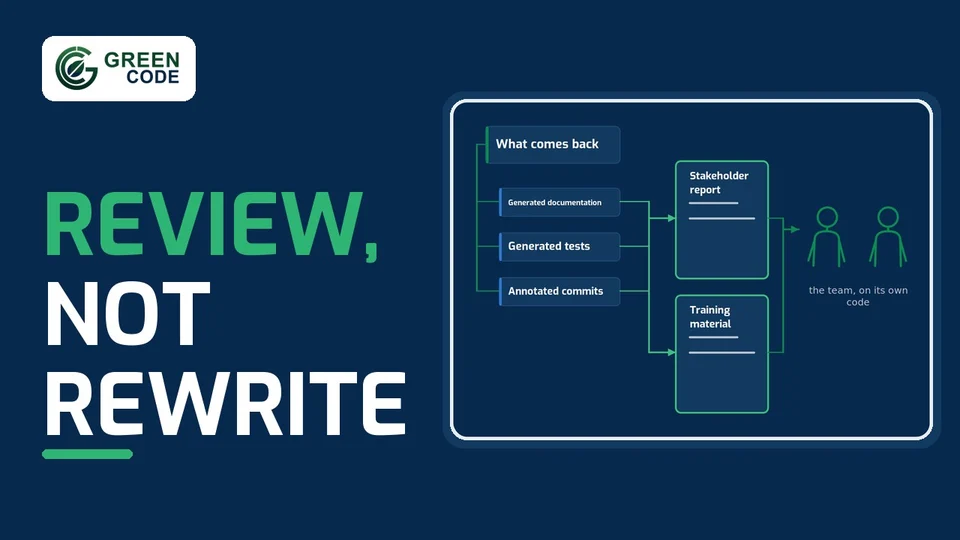
An engineering manager gets a mapped, documented and tested codebase, a stream of reviewable pull requests, stakeholder reports and bespoke training materials derived from the team's own code, so the knowledge stays with the team. Fewer hours go to comprehension and scaffolding; more go to features. The project intends to measure this rather than assume it.
The static code analysis work package builds the mapping index and artefact generators. The green NLP and AI work package covers code generation and porting models, and the processing pipeline work package covers automated load-test generation, development-workflow trials and the legacy migration use case.
Organisations that want to take part or trial the tooling on their own codebase can get in touch via the contact page.