

Every energy-using product sold in Europe carries a rating a non-specialist can read, except software. GreenCode rates a system before and after optimisation against an ISO-aligned standard, and returns the evidence behind the grade, so efficiency becomes something a buyer can specify, a regulator can test and a vendor can prove.
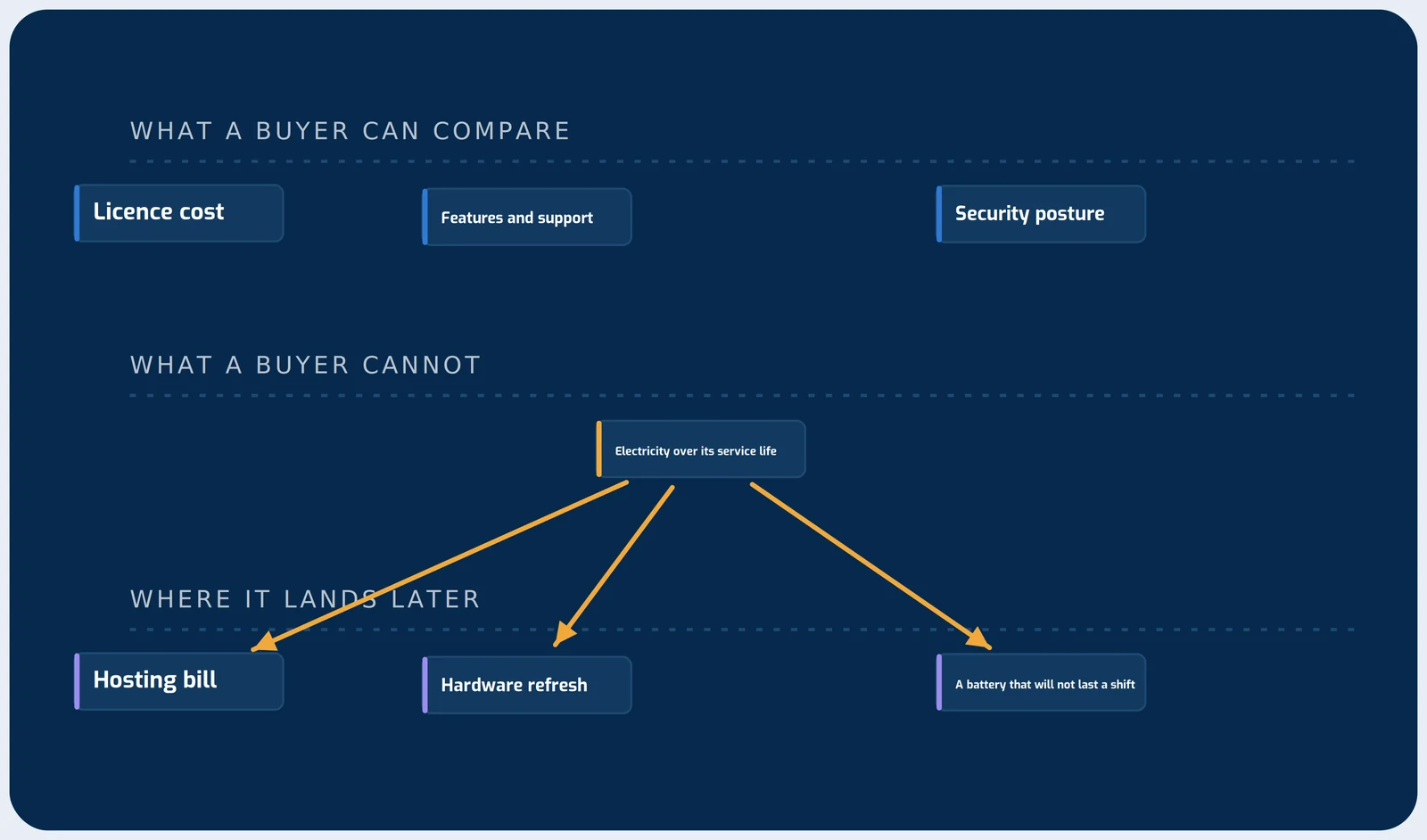
Almost every energy-using product sold in Europe carries a rating that a non-specialist can read at a glance. Software carries nothing. An organisation comparing two systems that do the same job can compare licence cost, features, support and security posture, but not the electricity the software will draw over its service life. That cost arrives later, as a hosting bill, a hardware refresh or a battery that no longer lasts a shift, and it is absorbed as a cost of doing business rather than attributed to the product that caused it.
 View full size
The gap is not a small one. Before artificial intelligence and blockchain are counted, information and communications technology already emits on a par with civil aviation, and most of that footprint is electricity spent running software. The people best placed to choose the more efficient option have no signal to choose on.
A rating is only worth building if somebody acts on it. Four groups would.
Behind all four is one condition: the measure must be the same everywhere, produced by a method anyone can repeat.
That condition is closer to being met than most people realise. Software Carbon Intensity, the measure developed by the Green Software Foundation, was adopted as ISO/IEC 21031 in 2024. It expresses the carbon cost of a defined unit of software work, and it aligns with ISO 14064 and the GHG Protocol, so a figure produced with it fits inside a corporate carbon inventory rather than sitting beside one.
An intensity figure is not yet a grade. The Software Carbon Efficiency Rating turns the measurement into a graded scale of the kind a buyer can act on. The Foundation's Green Software Patterns catalogue does the other half of the job, naming the code and infrastructure changes that reduce consumption, so a rating connects to the work that would improve it. Alongside them sits ISO/IEC 25010, the quality model that makes maintainability, reliability and performance efficiency assessable properties of software, which is what stops an energy saving being bought by degrading everything else.
GreenCode contributes to the Foundation's open-source rating and measurement tooling rather than running a private scheme, because a rating only its author can reproduce is worth very little.
 View full size
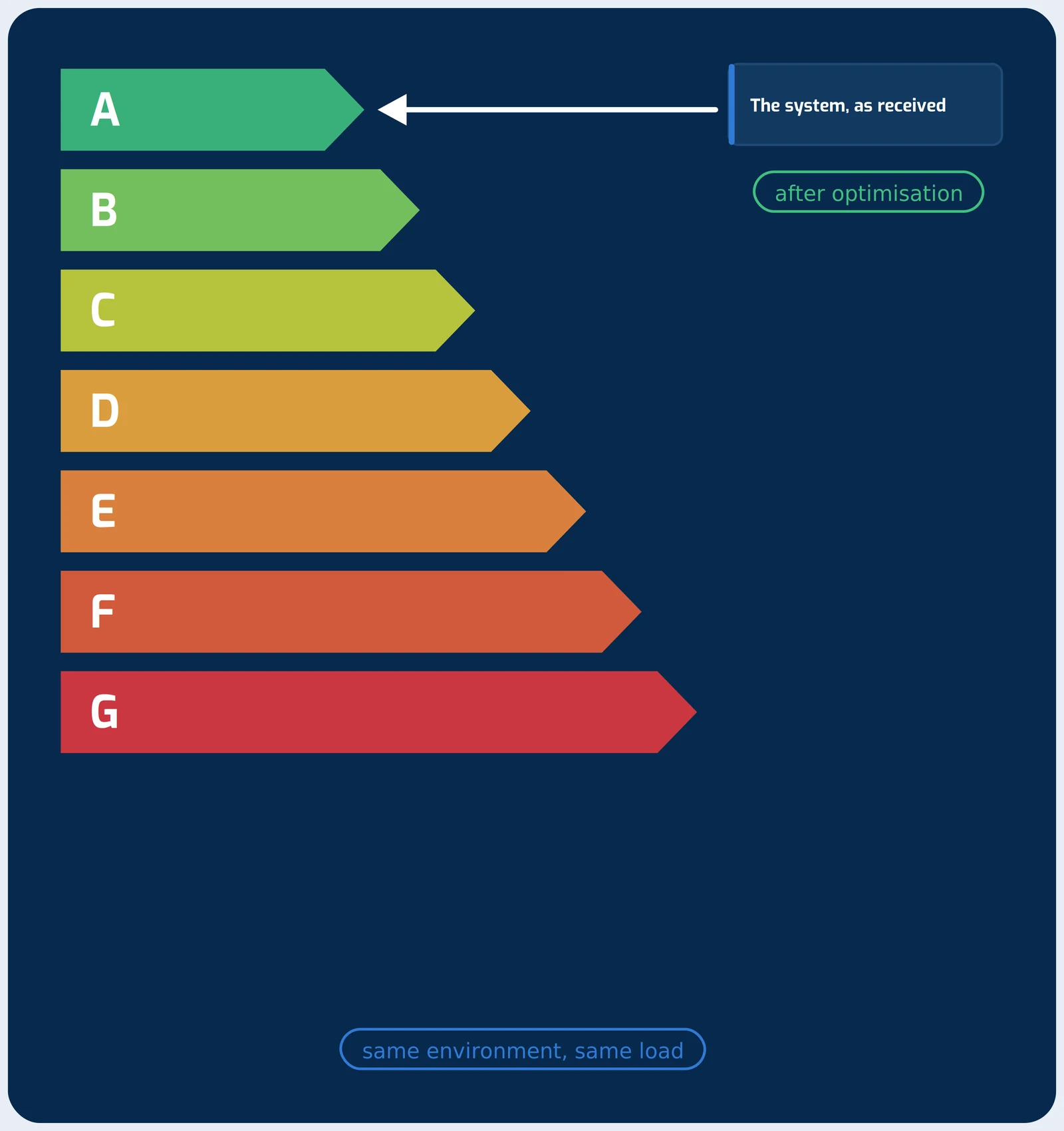
Certification is the final stage of the GreenCode pipeline, and it measures rather than changes. The system is rated as received, on infrastructure reconstituted from its own configuration, under a defined load. It is rated again after optimisation, in the same environment, under the same load. The gap between the two readings is the claim, and the project's own threshold is a net reduction of more than 15% per system with no increase in quality issues, security flaws or error rate.
The grade travels with its evidence: the measurement boundary, the load profile, the allocation rules, the tool versions, the test results and the specific changes that produced the reduction, each returned as a reviewable pull request. This is where existing practice falls down. Energy is sometimes measured, but rarely in a form that can be assured, certified or compared during procurement. How the rating is produced sets out the mechanism in detail.
Energy is measured directly for each system, and its carbon is reported against the Software Carbon Intensity standard, ISO/IEC 21031:2024. Where a system's infrastructure is in scope, the efficiency of the data centre it runs in is read against the ISO/IEC 30134 series of data centre key performance indicators, so that a saving in the software is not confused with a change in the building. Quality is tracked alongside energy: each optimisation pass records how many issues it found and how many it resolved, and the ratio shows whether the codebase is getting healthier as well as leaner. For context, industry experience puts defect density at around 15 to 50 defects per 1,000 lines of delivered code (Steve McConnell, Code Complete), which is the baseline a certified system is expected to improve on.
Reporting obligations are widening, and software sits inside them whether or not anyone measures it.
Green claims are the sharpest of these. An efficiency claim that cannot be substantiated stops being a marketing line and becomes a legal exposure, and a measured, standards-based rating is the kind of evidence these rules expect. Direct taxation of IT carbon emissions is a plausible next step, and several instruments above began life as voluntary practice. An organisation that already knows the rating of its estate, and can show the reduction it has achieved, is in a very different position from one starting from an unmeasured baseline.
Three things, in practice. It supports disclosure, because it turns an estimated Scope 2 and Scope 3 line into a figure with a reproducible method behind it, which is the subject of accurate ESG data for CSRD reporting. It substantiates green claims, because it records the steps taken as well as the status reached. And it gives procurement something to buy on, which is where a rating starts to change what suppliers build. What that means for a buyer is set out under certified software energy efficiency.
An easy to understand energy efficiency certificate for a software product is one of the deliverables GreenCode will bring. The consortium would rather it became a shared measure than a project artefact, which is why the standards work is done in the open.