

Wasteful software and poor quality software are usually the same software. GreenCode assesses a codebase against quality, security and green software standards in one pass, then fixes what it finds and re-measures, so energy optimisation starts from a system that is sound.
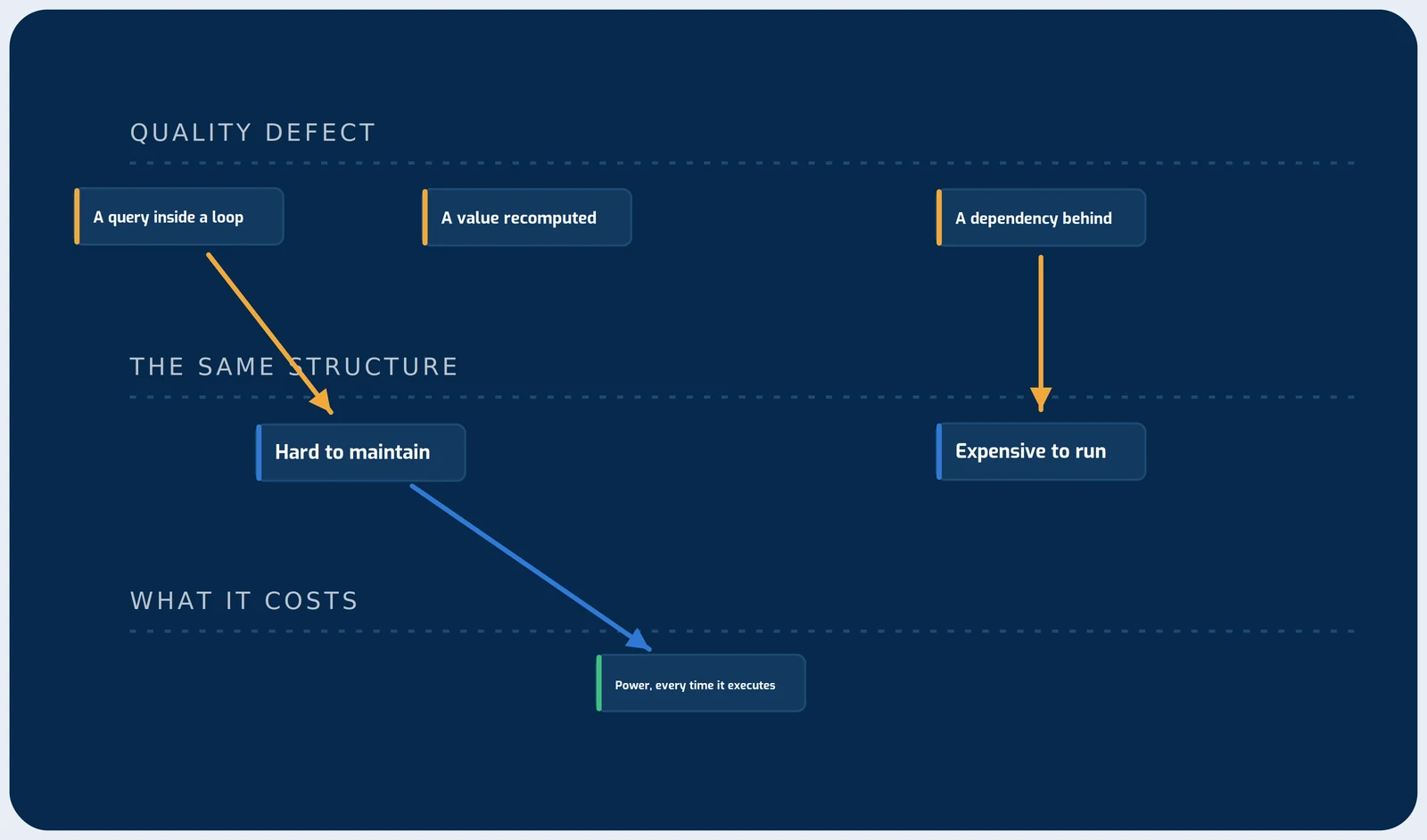
The structures that make software hard to maintain are usually the structures that make it expensive to run. A query issued inside a loop, a value recomputed rather than held, a dependency two major versions behind, a module nobody can safely change: each is a quality defect and each costs power every time the code executes. Research on developer choices has shown for a decade that ordinary implementation decisions move server energy consumption measurably, and the refactoring literature reports energy improvements of 10 to 30% from quality work alone, before anything energy-specific is attempted.
 View full size
The cost of getting this wrong is not hypothetical. CISQ put the cost of poor software quality in the United States at $2.08 trillion in 2020, spread across failures, rework, defective legacy systems and the operations they force. Short delivery cycles keep adding to it, because the fastest path to a working release is rarely the cheapest path to a running one.
That is why GreenCode does quality before energy. Optimising a system that is already unsound produces faster wrong answers. Fixing it first also removes a large share of the waste on its own, at a low energy cost, which is the cheapest saving available.
The analysis scores a codebase against three reference sets in the same pass and treats them as one subject. The ISO/IEC 25010 SQuaRE quality models cover maintainability, reliability, performance efficiency and the rest. OWASP practice covers security. The Green Software Foundation's green software patterns are used here as quality metrics rather than advice, so an energy-wasteful construct is recorded as a defect rather than a suggestion. A missing test, an unvalidated input and a needlessly repeated database call come out of the same analysis, in the same ranked list.
A second signal arrives later. When the benchmarking stage runs the system under load and records energy against individual code constructs, those measurements are fed back into the assessment. Code that passes static analysis but draws disproportionate power is then treated as defective. These are the sustainability smells the project set out to detect and name: patterns that are functionally correct, pass review, and quietly cost a fortune at scale. Detecting them is what makes energy a property a team can act on rather than a total on a bill.
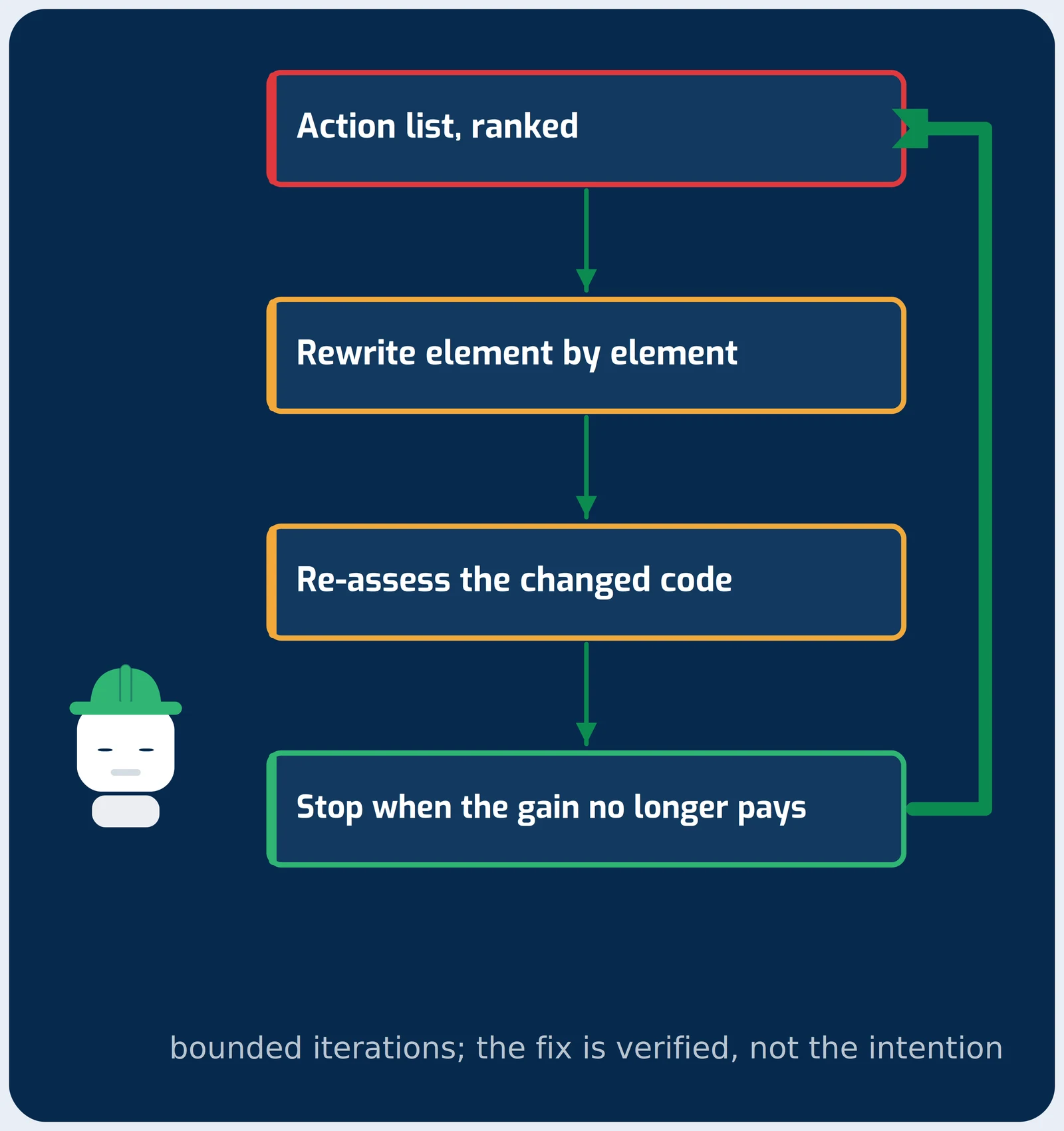
Detection without remediation is where most tooling stops. Monitoring products report and leave; static analysers find and do not fix. GreenCode is built to close the loop.
 View full size
Two gates hold the whole thing honest. The maintainability index, computed from lines of code, cyclomatic complexity and Halstead volume, must come out above 85, with cognitive complexity stable or reduced. And the combined count of quality assessment issues, security flaws and error rate must not rise across a cycle. Generated code is held to exactly the same standard as human code and is checked rather than trusted. That is the failure mode of naive automated refactoring, and it is designed out rather than hoped away.
The published review of static code analysis found the field strong on correctness and weak on energy. Formal verification, model checking and abstract interpretation give precise answers but scale poorly to the multi-million line estates that need help most, so the review favours combining them with lighter analyses that can run on every commit. It also looked at analysers for compiled software, which matters where source is unavailable or where the compiler, not the author, decides what actually executes.
The same review is candid about generated code, reporting only a weak correlation between functional correctness and code quality in AI-generated software. The wider state of the art review adds that the common coding benchmarks ignore energy altogether, so a tool can score well while producing inefficient code. Independent reviews of software energy efficiency tactics reach a similar conclusion and call for exactly this kind of academic and industrial collaboration. All of it points one way: measure at every step, and verify the fix rather than the intention.
Four things come back. A ranked list of defects, covering quality, security and energy waste together, with the standard behind each one named. An action plan that says what should change and in what order. The fixed code itself, on an optimisation branch, as documented pull requests that a maintainer approves or rejects. And a report, readable by someone who does not write code, showing what the re-assessment measured after the changes were made.
The detail of the analysis is set out under sustainability led code quality assessment, the remediation under automated software maintenance, and the outcome for a team under reduced software issues. Once this baseline holds, the pipeline moves on to infrastructure, benchmarking and the energy work described in energy and cost reduction.
Want the assessment run against your own codebase? Talk to the GreenCode team about a use case.
Get in touch