

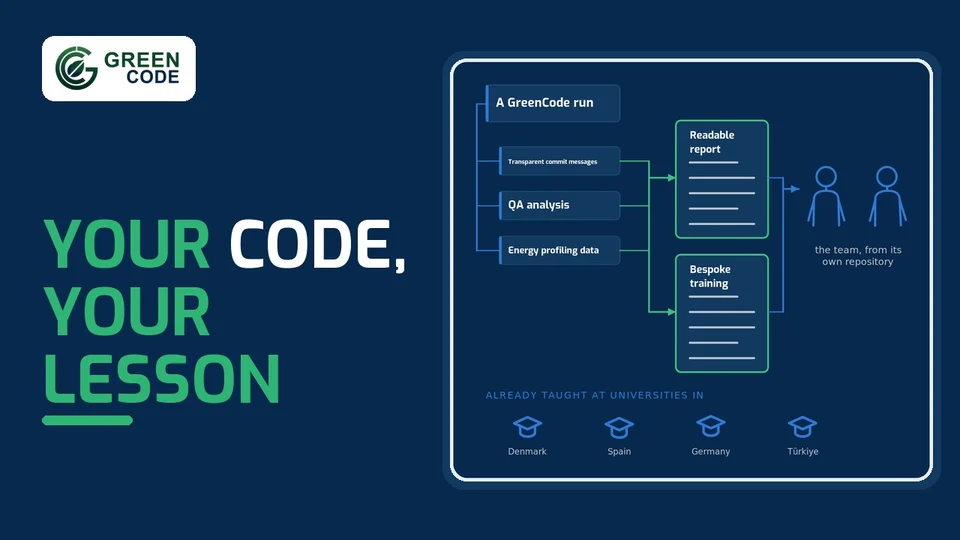
GreenCode turns the optimisation of a team's own code into training material, and its university partners are teaching energy-aware programming to the next generation of engineers.
Most software engineers have never been taught how their design choices affect energy use. GreenCode's state-of-the-art review records that the Software Engineering Body of Knowledge, the reference used for many curricula, has yet to include sustainability as a core area of competence, that energy-efficient practices are not consistently taught in mainstream courses, and that most development environments give no feedback on the energy impact of a coding decision. The Green Software Foundation set out to certify one million developers, roughly 3.6% of the global total, by the end of 2023, but its materials have not yet had wide dissemination or real-world testing, and the review estimates the GSF's membership at under 1% of the industry.
For engineering leaders this is a skills gap to close while also shipping. For universities and professional bodies it is a curriculum gap: demand for engineers who can measure and reduce software energy is outpacing the teaching. The consortium identifies educational gaps, competing priorities, the ability to measure impact and the productivity cost of optimisation as the main barriers to uptake.
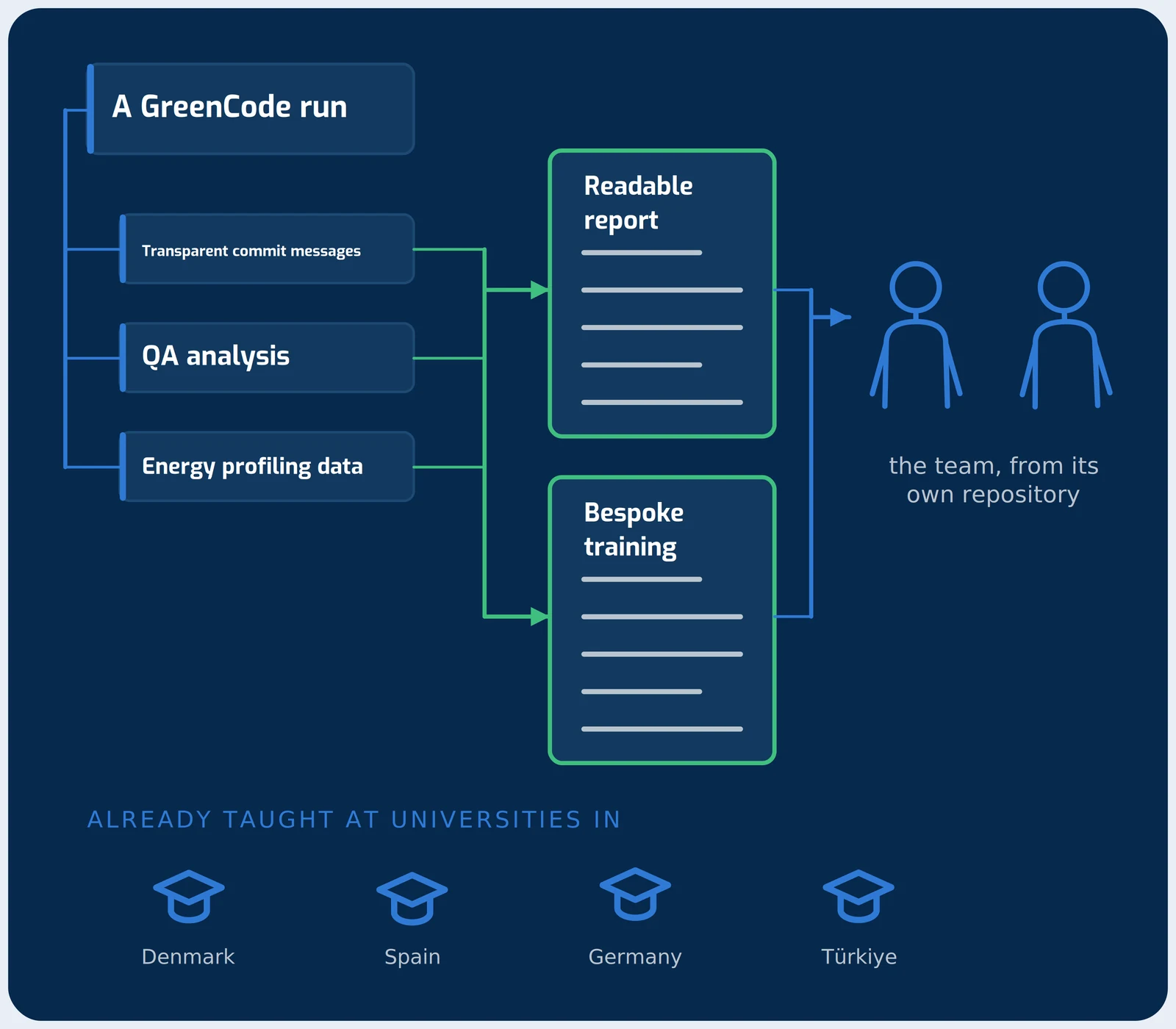
GreenCode makes training a by-product of doing the work. As the pipeline refactors a codebase it writes transparent commit messages describing each change and records the QA analysis and energy profiling data behind it. At the end of a run that record is turned into human-readable reports and bespoke training materials prepared with reference to the team's own code. The reasoning is that a lesson drawn from the developer's own repository sticks better than an abstract best-practice document or a generic list of flaws.
 View full size
Two further mechanisms support this. First, GreenCode publishes evidence: it produces measurements that show whether a given green software pattern actually reduced energy in a real codebase, and feeds validated patterns back to the Green Software Foundation's pattern database. Second, successive analysis of a team's projects gives an indication of how sustainably the team works over time, pointing to where training is needed. The review adds that because GreenCode applies green principles on the developer's behalf, the message reaches teams that formal education would not.
On the tooling side, the preliminary requirements set out three related items: FR23, the generation of bespoke training materials derived from the codebase and its optimisation decisions; S4, codebase-specific training and guidance for workforce upskilling; and TTE3, documentation, training artefacts and partner-facing workshops to support transfer into partner organisations. Reporting tools render the pipeline's intermediate outputs as readable reports for developer understanding and team practice review.
On the teaching side, the material is already in front of students:
The courses and where they are taught are listed on the teaching page.
For an engineering team, a GreenCode run yields not only pull requests but a record of why each change reduced energy, expressed in their own code. The code also stays intelligible: the pipeline checks that optimised code remains understandable and documented, so it is something a developer can learn from and build on.
For universities and professional bodies, GreenCode supplies measured evidence and worked examples from real industrial codebases. The project's stated aim is high-quality, customised training that raises developer skills in quality, security and sustainable software development, so that sustainable practice becomes embedded rather than episodic.
The training outputs are generated in the final certification and reporting stage of the processing pipeline. The dissemination, exploitation and standardisation work package covers academic publication and teaching activities, internal training of partner development teams in green coding practices, the contribution of new green software patterns to the GSF, evidence-based validation of GSF recommendations and the reporting tools.
Universities, training providers and engineering organisations that want to host a course, adopt the teaching material or trial the training outputs on their own code can get in touch.