

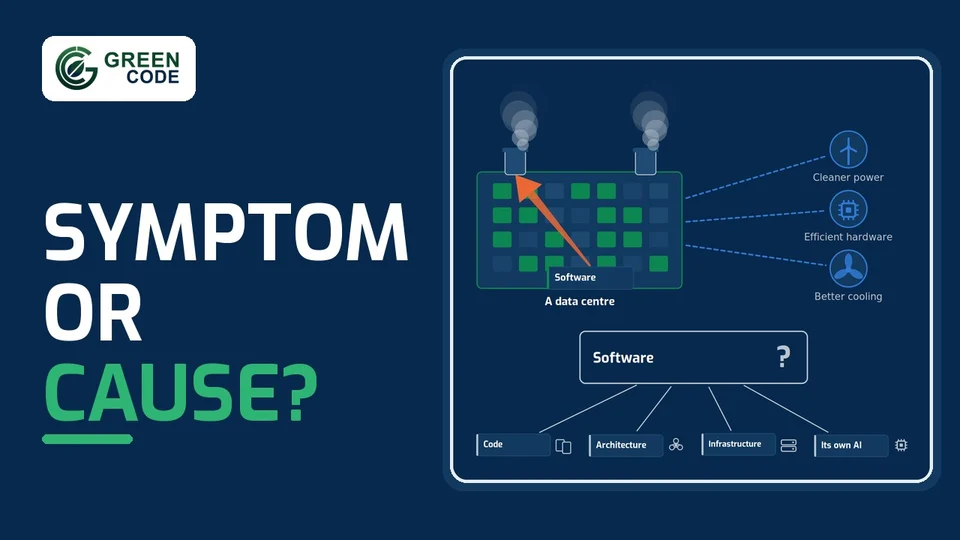
Software energy waste is the root cause of ICT's operational emissions. GreenCode cuts it at source, then rates and certifies the result so the reduction can be reported and relied on.
 View full size
The ICT sector is estimated to be responsible for 2 to 4% of global greenhouse gas emissions, rising to around 14% by 2040 if unchecked, according to projections cited in GreenCode's state of the art review. Excluding AI and blockchain, the sector's footprint is already comparable to aviation.
This is now a reporting obligation. The EU Corporate Sustainability Reporting Directive requires companies to disclose their environmental impacts, and public sector procurement increasingly attaches sustainability conditions to software and IT purchases. An enterprise customer under pressure on its Scope 3 emissions will ask its software vendors what they are doing about theirs.
The difficulty, as the review notes, is that these frameworks say little about software specifically, and the standards that do concentrate on quantifying emissions rather than reducing them. An organisation can comply and still run the same wasteful code.
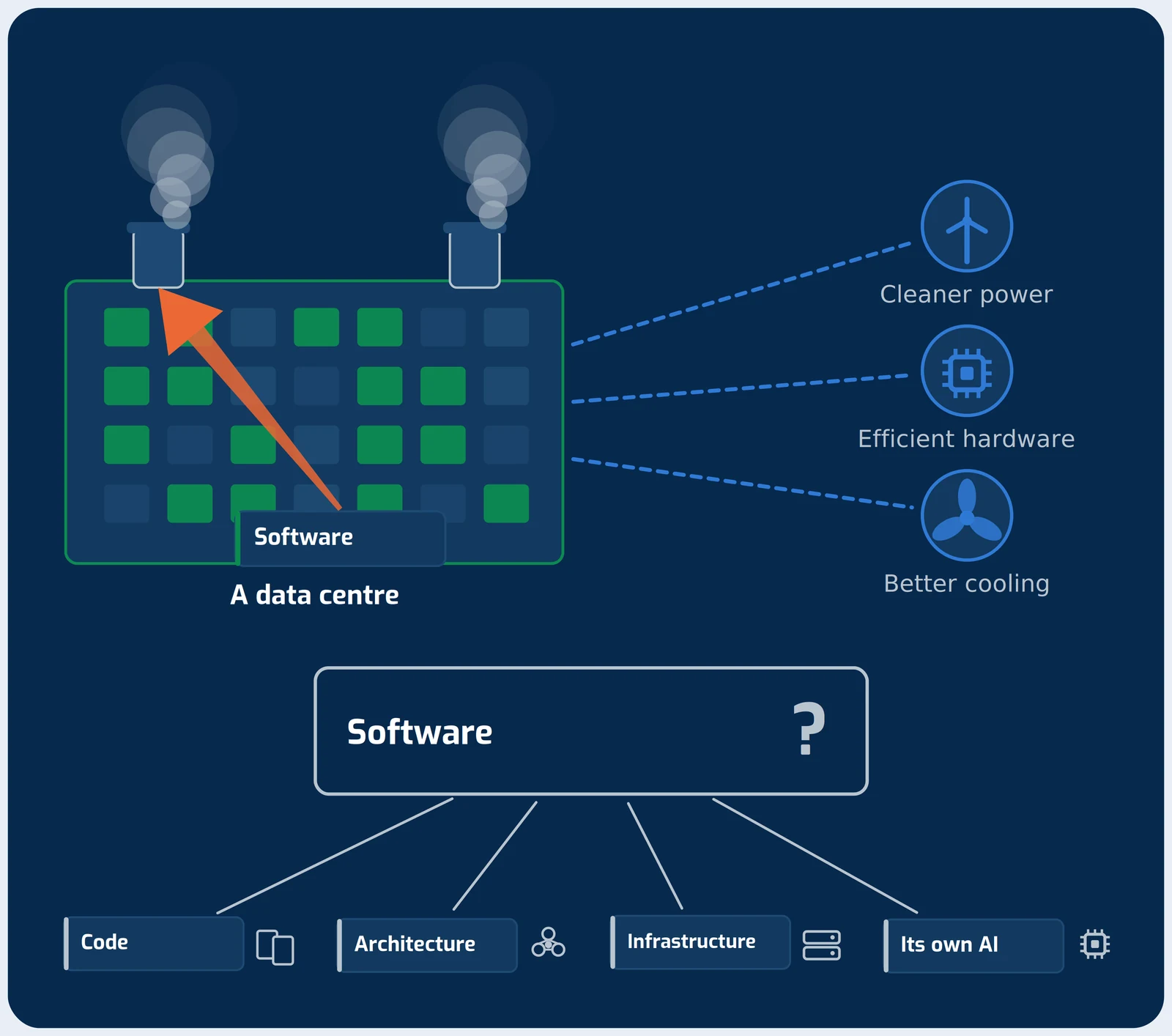
GreenCode's position is that energy waste in software is the root cause of operational emissions in IT, and that cleaner grid supply, more efficient hardware and better data centre design treat the symptom. Those measures lower the carbon intensity of each kilowatt-hour. GreenCode lowers the number of kilowatt-hours.
Its automated pipeline takes a working codebase, establishes a measured energy baseline, attributes hotspots to specific code and infrastructure, uses specialised generative AI to refactor them, and re-measures until the gain is verified. Changes come back as reviewable pull requests, so a human stays in the loop. The project targets a net energy reduction of more than 15% per software product processed, with no regression in quality, security or maintainability.
The pipeline must also account for its own footprint. The requirements ask GreenCode to measure and minimise the energy and carbon of its own operation, and the project is working on energy-efficient fine-tuning and on small self-hosted models of 3 to 13 billion parameters so that the AI doing the optimising does not cancel out the savings. It is also developing methods that combine energy and performance metrics with the energy mix, so that design reflects how clean the supply is.
WordPress runs around 43% of all websites, and on the climate case model a 7 to 10% efficiency gain across its core and top 100 plugins could cut 0.7 to 1 million tonnes of CO2e a year once deployed, at the European grid average. The optimisations found in that use case will be contributed back to the WordPress community.
On the reporting side, GreenCode builds on the Green Software Foundation's Software Carbon Intensity (SCI) specification, adopted in 2024 as ISO/IEC 21031:2024. SCI defines carbon emissions per functional unit of software and aligns with ISO 14064 and the GHG Protocol, which a CSRD disclosure needs. The consortium contributes to the GSF's pattern library, Impact Framework and Software Carbon Efficiency Rating (SCER), and rates every software product against SCER at the start and end of processing. The target is an "A" rating, meant to work like the EU energy label on an appliance: a simple signal that buyers and ESG officers can act on. The consortium expects some companies to deploy only A-rated software as a matter of ESG policy.
Use cases record energy before and after in watts and CO2e, grade outcomes on an A to G scale for automotive OEM customers, and target energy-constrained aviation and electric vehicle systems.
For a sustainability lead, GreenCode offers a measured, standards-based reduction in the emissions of specific software products, evidence that supports Scope 2 and Scope 3 reporting, and a rating that can be shown to customers and regulators.
For a software owner or vendor, it turns carbon from a compliance cost into a product attribute: the same optimisation lowers hosting bills and extends hardware life, reducing embodied carbon and electronic waste. For a public sector buyer, it is a way to write energy efficiency into procurement without a specialist assessment on every tender.
Energy certification sits in the processing pipeline work package, which rates software against SCER at the start and end of processing and builds the benchmarking that produces the before-and-after numbers. Other work packages provide the energy measurement toolkit those measurements run on, the code QA toolkit that treats GSF green software patterns as quality metrics and the energy-efficient AI models that keep the pipeline's own footprint low, and the standardisation work package coordinates the contributions to GSF specifications.
To trial the tools or contribute a use case, get in touch through the contact page.