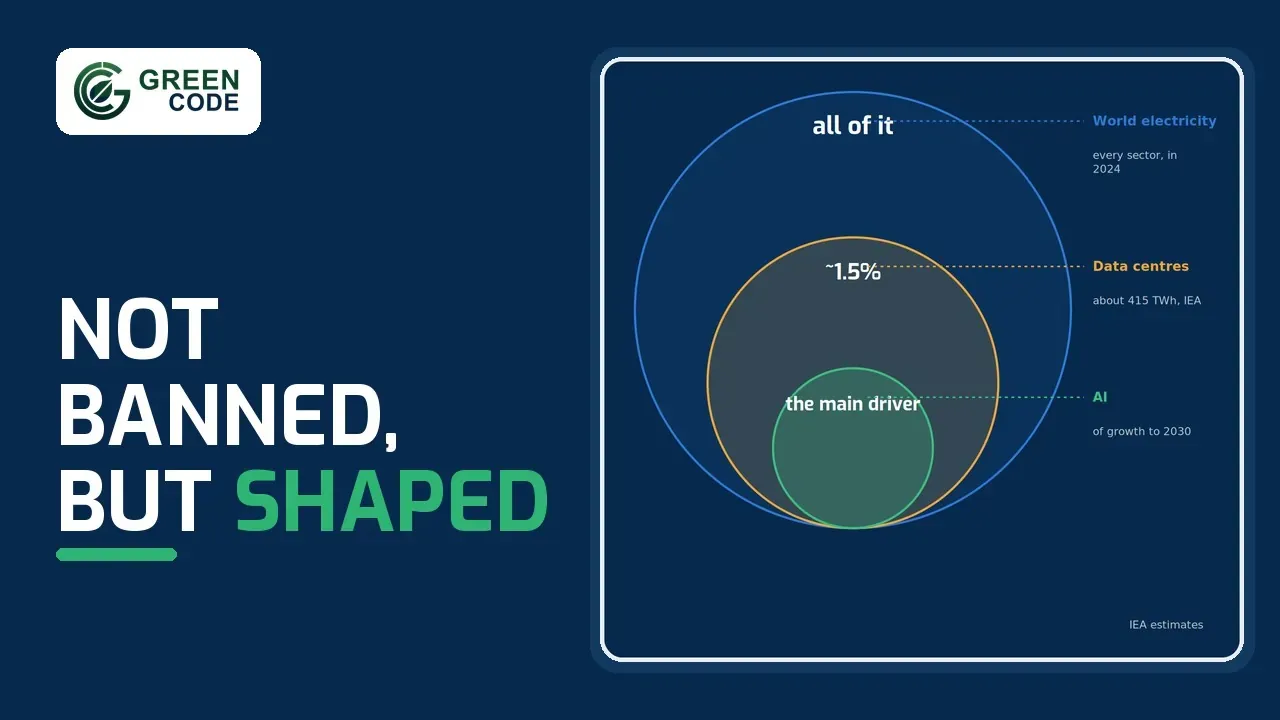
Data centres already use around one and a half per cent of the world's electricity, a share expected to more than double by the end of the decade. This film looks at how policy and everyday practice, rather than bans, can keep the energy of software and AI in proportion to the value they deliver. It is for anyone who funds, buys or regulates digital services.
Read the full page Watch on YouTube
AI is now woven into how software is built and used, and no law will remove it. The useful question is how its energy, and that of the systems around it, stays in proportion to the value they deliver. Data centres already use around one and a half per cent of the world's electricity, a share expected to more than double by the end of the decade, with AI the biggest driver. Efficiency alone guarantees nothing, because each gain can increase total consumption: the rebound effect. So the answer lies in policy and practice, not prohibition.
The first saving is not to reach for AI where a simpler method will do, and public funders and buyers can ask projects to show they have assessed the need. Where it is justified, the choice matters. For the same task, general-purpose generative models can cost orders of magnitude more to run than systems built for it. Classification, extraction and forecasting are often well served by classical machine learning or small specialist tools. Use matters too: energy rises with what goes in, what comes out and the size of the model, so short, well-structured prompts cost less, and that is a skill organisations can teach.
Training runs, batch inference and large data processing jobs can often wait a few hours. The carbon intensity of the grid varies through the day, and forecasts are openly published, in Great Britain predicting it for each region more than four days ahead. Public compute programmes and cloud framework agreements can require flexible workloads to follow those signals. Energy policy can go further, rewarding data centres that shift load rather than treating them as fixed demand.
Organisations using AI services are rarely told how much energy their requests consume. That can change. One large provider has published a method for measuring the energy, emissions and water of a typical text prompt, and its authors argue that comprehensive measurement is needed to compare models and reward efficiency. Where governments build or buy central AI services, they can require inference to be metered and reported back to each user organisation, since people change behaviour when they can see what it costs. European rules already oblige larger data centres to disclose energy and sustainability indicators, and are moving towards a common rating scheme.
Every new device carries the emissions of its manufacture, so the longer each stays in use, the fewer must be made. Policy can ask whether a refresh is truly necessary, and treat forced obsolescence as a problem. European rules for phones and tablets now require operating system updates for at least five years after a model's last sale. Efficient code helps too, because software that needs less memory and processing runs well on older hardware. Security can pull the other way: when an operating system reaches end of support, working machines are often retired for that alone. Guidance on cyber risk and sustainability policy should be reviewed together. France already publishes ecodesign criteria for websites, applications and AI tools, aimed at longer device life, lower resource use and more transparency. Requirements like these can be built into public procurement from the start. A simple baseline, a government-backed minimum standard with a few controls, as the UK already has for cyber security, paired with tax credits for measured improvements, would give smaller suppliers a clear first step. Sharing what works openly avoids duplicated effort. Reach out to us with the digital, energy or AI policy you are shaping, and we will help you understand how GreenCode can inform it.
Article film
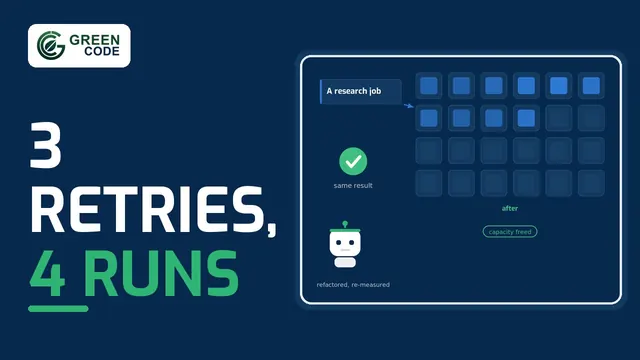
On one national university cluster, about half the energy went on jobs that ended unsuccessfully, though not all of it was wasted.
Article film
AI is growing fast, and so is the electricity behind it: data centre use worldwide is expected to more than double by the end of the decade, with AI the biggest driver.
Overview film
Better cooling, processors and power are all being built.