Better cooling, processors and power are all being built. The software they exist to run stays a black box, and the legacy code that runs much of the world is the blackest box of all.
The world is waking up to the environmental cost of data centres. Most of the effort so far goes into the hardware and the building: better cooling, more efficient processors, cleaner power. All of it necessary. But a data centre exists to run software, and inefficient software makes an inefficient data centre, whatever the hardware.
Software is treated as a black box: nobody can see which code, which servers, which traffic is spending the energy. And much of the software running the world is legacy code that nobody has looked inside for years. That is the blackest box of all. GreenCode measures the whole application under real load and sets a baseline you can repeat.
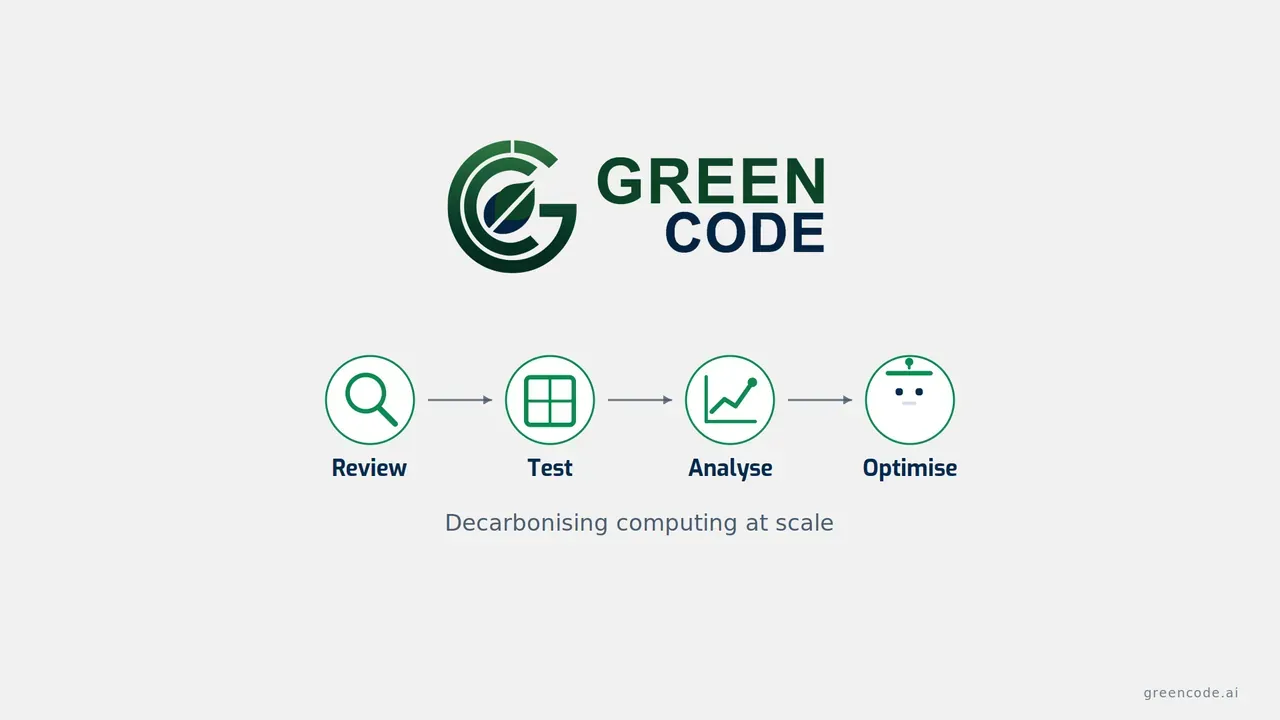
Then it attributes that energy downwards: to the virtual machine it runs in, to the application and its services, to the individual function that spends it, and to the engineer who owns it. Every level named, and every level linked to the one above. Nine stages, and it is a loop. Set up a test.
Find the endpoints. Load-test and measure the energy. Observe and store everything. Analyse the code quality, pick the targets, and refactor them with AI.
Report. Then re-test under the same load, and go round again. Your codebase goes through three steps: measured under load, hotspots ranked, then refactored with AI against a library of green coding practices. Out come the pull request, for a person to accept or refuse; the energy report; the evidence bundle; the carbon rating it is measured against; and others.
Infrastructure is code too. GreenCode discovers the servers, storage and network an application actually runs on, and writes them back as infrastructure code. Then it optimises that code: right-sizing what is oversized, consolidating what is scattered, switching off what nobody uses. And it rebuilds the environment from the code, so the result can be measured again.
Not every job has to run now. Training a model, a nightly rebuild, a batch of optimisations: these are intensive, and they can wait. GreenCode schedules that work for the hours when the grid is cleanest, using forecasts of supply, and holds it back when the grid is dirtiest. The same work, the same result, less carbon.
Here is where the leverage is. Optimise one application for one deployment and you save a little, and the AI that did the work may have cost as much as it saved. But most software runs in thousands of places: the same content system on nearly half the web, the same libraries in every build. Optimise it once, at source, and every deployment inherits the saving.
That is the step change. One pipeline, shaped by real partner use cases: web and SaaS, mainframe, automotive, aerospace, cloud, public sector, data, media. Most of the world's software is legacy, and that is where GreenCode is aimed. The fastest way to judge it is on your own system.
Bring us a real codebase and watch GreenCode measure it, find the hotspots, and hand back the pull requests and the evidence. GreenCode is a European research consortium, backed by ITEA and Innovate UK.
Overview film
Computing already emits about as much carbon as civil aviation, and most of that is electricity drawn while equipment is running.
Overview film
Computing already emits about as much carbon as civil aviation, and most of it is electricity spent running software.