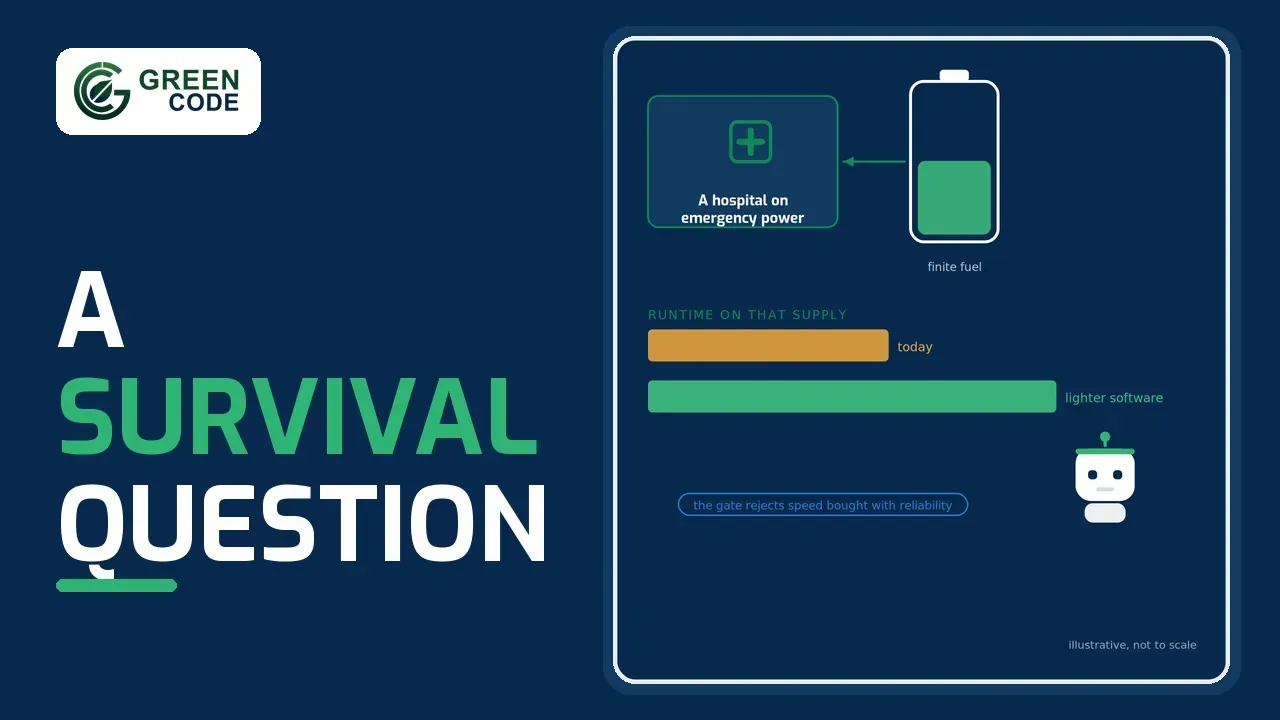
In hospitals, aircraft and electric vehicles, software efficiency is a survival question: a system that draws less power runs longer on whatever reserve is left. This film shows why power supply is becoming less dependable, how an uncaught software change can cause an outage of its own, and how GreenCode tests critical code and cuts its energy demand with a human approving every change.
Software efficiency is usually argued as a cost or a carbon question. In systems that must not stop, it is a survival question. A system that draws less power runs for longer on whatever reserve is left, and a system that has been properly tested is less likely to be the thing that fails. Both are engineering properties of the code, and both are normally left to chance. In an aircraft or an electric vehicle the energy budget is fixed and carried on board. In a hospital running on emergency generation the fuel is finite, and the load is whatever the systems demand.
The power supply is getting less dependable. Climate change is expected to bring more frequent and more severe disruption to generation, transmission and distribution. Healthcare providers face rising costs and an increased reliance on contingency generation. And the renewable transition, welcome as it is, adds supply that varies with the weather and the time of day. A system designed around constant, abundant power behaves differently when the supply is intermittent. Efficient software is the cheapest way to widen that margin, because it changes the demand rather than the supply, and it can be deployed to equipment already in the field.
Resilience is not only about energy. The clearest recent illustration of what inadequately validated software costs when it reaches critical infrastructure was a faulty update that disabled machines worldwide and disrupted airlines, hospitals and payment systems for days. It was not a power failure or an attack. It was a change that was not caught. That failure mode is well understood: compressed delivery schedules introduce defects, and the same functionality written differently consumes measurably different energy on the same server. Quality and energy are two readings from the same property: how well the software was built.
GreenCode's pipeline attacks both halves. It begins by mapping the codebase and generating the unit tests and documentation that critical legacy systems are usually missing, so behaviour is pinned down before anything is altered. Static analysis produces a worklist, and a combined measure of quality issues, security flaws and error rate is checked at every pass and must not rise: improvements that would trade reliability for speed are rejected by the gate, not by a reviewer's judgement. Then it removes the energy hotspots, benchmarked on a reconstruction of the system's own infrastructure, with a human approving every change. For the operator, that is more runtime on a generator, more range in a vehicle, and more headroom when the grid is unstable. The same efficiency enables capability, not just survival. Software that needs less compute and memory lets sensing, control and AI workloads run on edge hardware in places where power and connectivity are both scarce, doing more of the work locally and depending less on the network link, which in a disaster is often the first thing to go. An operator gets three things: a codebase with the tests its risk profile requires, a measured reduction in what it demands of its power supply, and evidence of both for a regulator or an assurance team. Reach out to us with the system that must not stop, and we will help you understand how GreenCode can widen the margin it runs on.
Benefit film
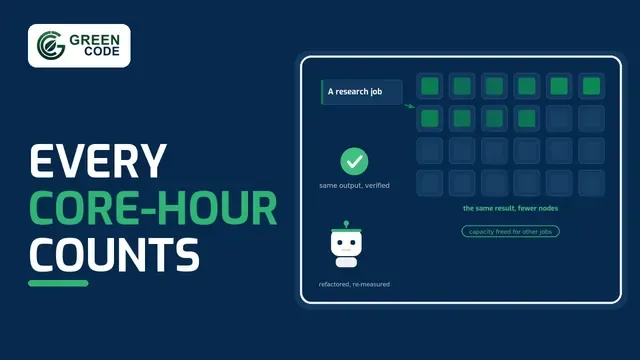
In research computing, a wasteful inner loop is multiplied by every core-hour a job runs, and much scientific software has never been profiled for energy.
Benefit film
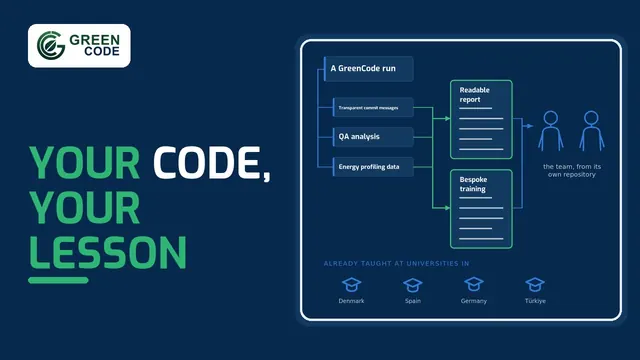
Most software engineers have never been taught how their design choices affect energy use.
Benefit film
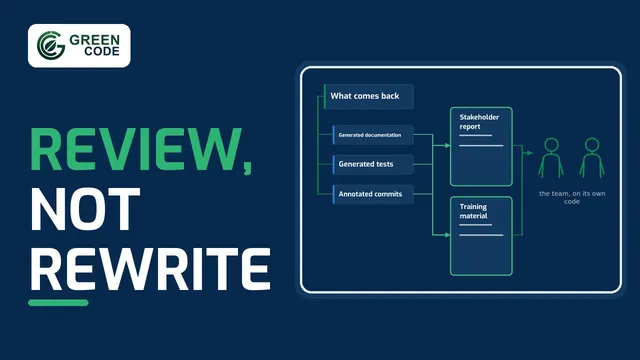
A large share of engineering time goes not on new code but on understanding old software, often with documentation incomplete or outdated.