Most software engineers have never been taught how their design choices affect energy use. This film shows how GreenCode turns its own work into training, explaining each change in the team's own code, and how measured evidence and university courses are bringing energy-aware programming to more developers.
Most software engineers have never been taught how their design choices affect energy use. The question a developer cannot answer at the keyboard is simply: where does this design choice spend energy? Neither the body of knowledge behind the curricula, nor mainstream courses, nor the development environment, nor the certification schemes yet answer it, and around all of them sit time pressure, and weak incentives. For engineering leaders that is a skills gap to close while also shipping. For universities it is a curriculum gap.
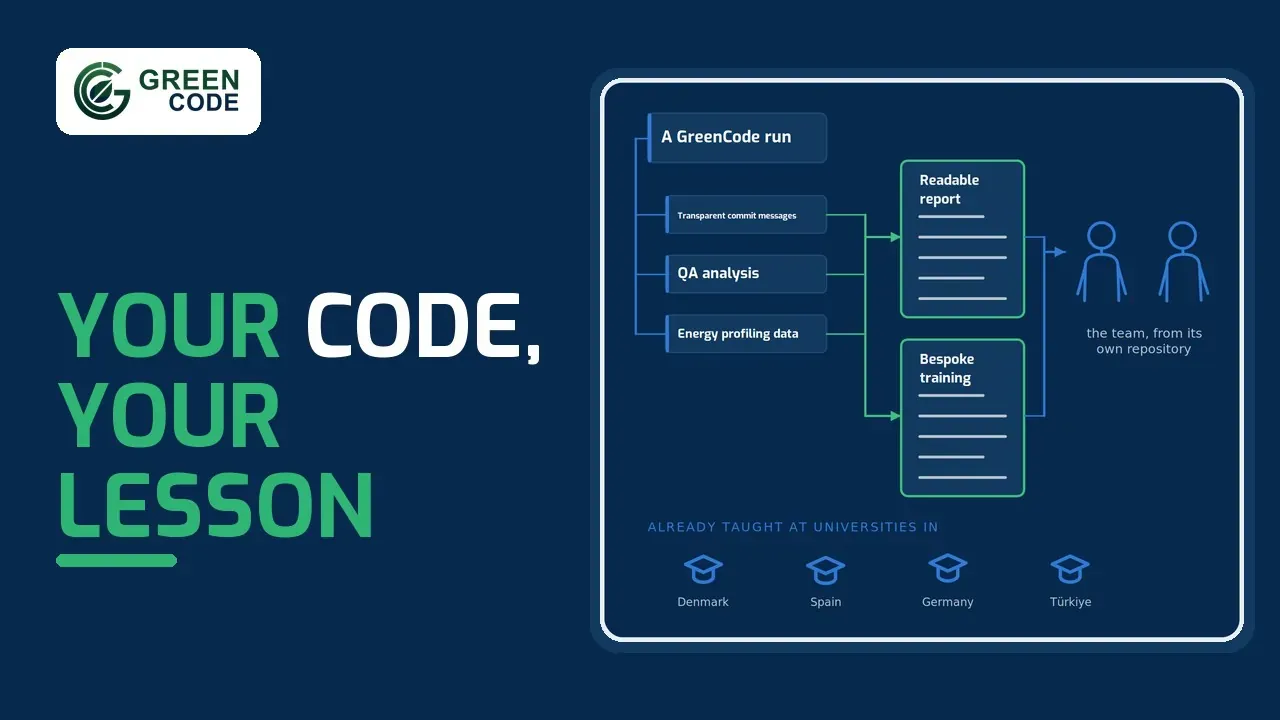
GreenCode makes training a by-product of doing the work. As the pipeline refactors a codebase it writes transparent commit messages describing each change, and logs the QA analysis and energy profiling data behind it. At the end of a run that record is turned into human-readable reports and bespoke training materials prepared with reference to the team's own code. The reasoning is that a lesson drawn from the developer's own repository sticks better than an abstract best-practice document or a generic list of flaws.
Two further mechanisms support this. First, GreenCode publishes evidence: it produces measurements that show whether a given green software pattern actually reduced energy in a real codebase, and feeds validated ones back to the pattern database. Second, successive analysis of a team's projects gives an indication of how sustainably the team works over time, pointing to where training is needed. And because GreenCode applies green principles on the developer's behalf, the message reaches teams that formal education would not.
On the tooling side, three related items are planned: bespoke training material derived from the codebase and its optimisation decisions, codebase-specific guidance for upskilling a workforce, and documentation, learning artefacts and partner-facing workshops to support transfer. On the teaching side, the university partners are already putting the material in front of students: a master's course on energy-aware programming, a green software training programme run in a capital city and online, students taught to conduct empirical measurement studies, a cloud energy course with a lab on real infrastructure, and green IT in regular lectures on software architecture. For an engineering team, a run yields not only pull requests but a record of why each change reduced energy, expressed in their own code, which stays intelligible, so it is something a developer can learn from and build on. For universities and professional bodies, GreenCode supplies measured evidence and worked examples from real industrial codebases, so that sustainable practice becomes embedded rather than episodic. Reach out to us with the team you want to bring up to speed, and we will help you understand how GreenCode can teach them from their own code.
Benefit film
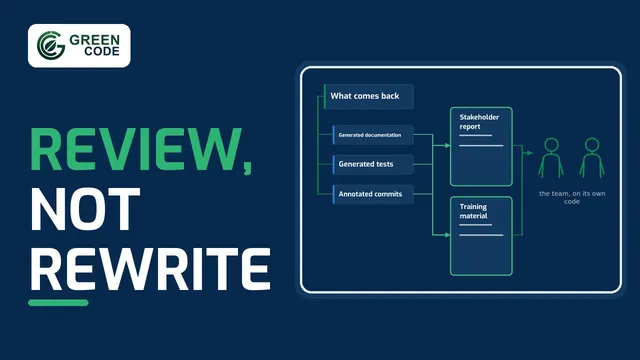
A large share of engineering time goes not on new code but on understanding old software, often with documentation incomplete or outdated.
Benefit film
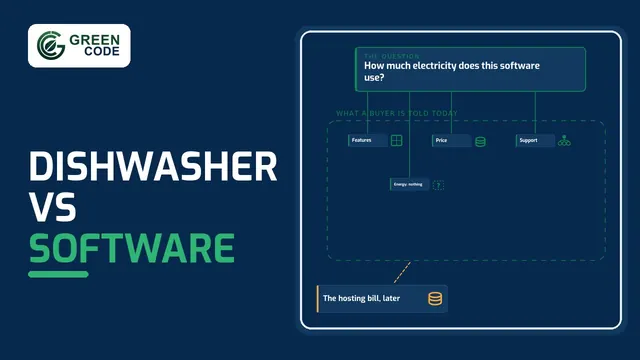
When an organisation buys a dishwasher it is told how much electricity the machine uses; when it buys software it is told nothing at all.
Benefit film
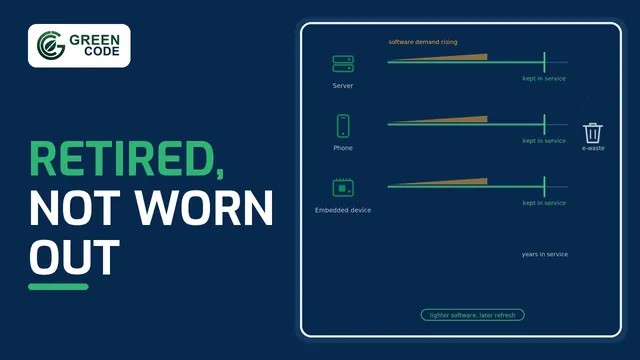
The world produced 62 million tonnes of electronic waste in 2022, and under a quarter of it was documented as formally collected and recycled.