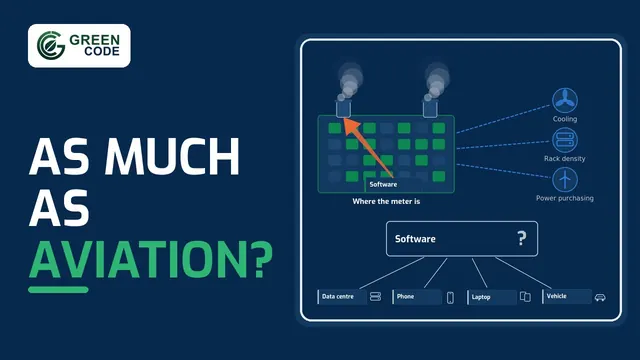
Computing already emits about as much carbon as civil aviation, and most of that is electricity drawn while equipment is running. This film sets out GreenCode's climate case, a business case for carbon: why the saving would not happen anyway, how much is within reach and what one run is worth. The figures are modelling, not measurement, until the use cases report.
A business case asks whether an investment pays. A climate case asks the same question of carbon. It sets out how an intervention cuts emissions, whether the cut would happen anyway, how much carbon is within reach, what the intervention costs in carbon itself, and where the boundary of the sums is drawn. Put together, it is the argument that a piece of work is worth doing for the climate, made in a form that can be checked. Computing already emits about as much carbon as civil aviation, and data centre electricity is expected to more than double in four years.
Operators have attacked the building: cleaner power, better cooling, denser racks. They have not touched the cause, because the software they host is a black box to them. Most of the sector's footprint is electricity in use, and it is software, the code, the infrastructure it asks for and the AI it runs, that decides how much of it is drawn. A climate case has to show the saving would not happen anyway, and for software energy it would not, for four reasons.
Maintenance is done grudgingly, and energy is never on the list. The skills are scarce: even the largest training target would reach under one developer in twenty. Today's tools watch rather than act. And legacy code, most of what runs, is where the waste sits and where nobody has the budget to intervene by hand.
Start from the electricity the whole sector used in a recent year: about three hundred and sixty million tonnes of carbon dioxide equivalent at the European grid average, and growing fast. Set networks aside, and what remains is the software running in data centres and on devices. Ordinary refactoring saves between ten and thirty per cent. At the central value, the carbon software optimisation could remove is well over a hundred million tonnes a year now, and several hundred million within the next decade.
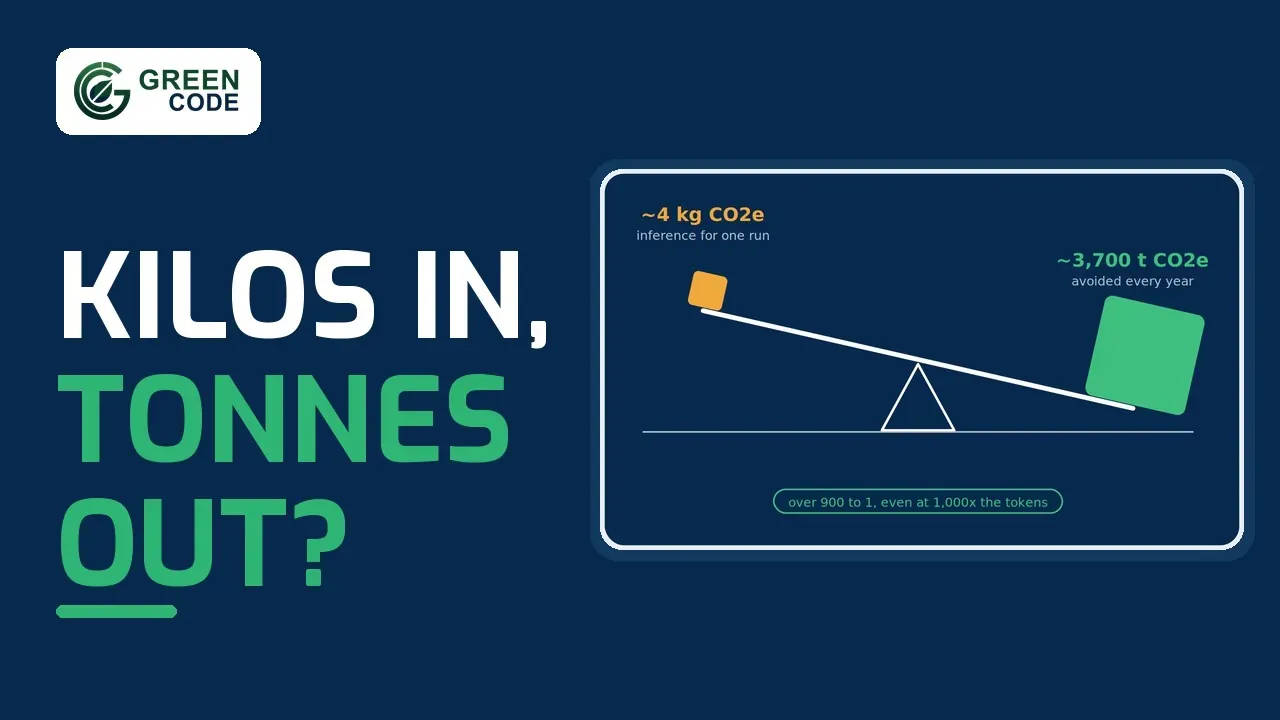
Take one widely deployed open-source database engine: over seven million lines of code, running in tens of thousands of deployments. On the model it emits around sixteen thousand tonnes a year, and clearing its technical debt by hand would take some two hundred and fifty developer-years. The pipeline would spend a few kilograms of carbon on inference and avoid thousands of tonnes a year. Even at a thousand times the modelled tokens, the return is over nine hundred to one.
The model draws a deliberately narrow boundary. On the cost side it counts the pipeline's own footprint: the inference on every run, the training of its models, and the benchmarking that proves a saving. On the saving side it counts only the electricity the optimised software stops drawing. Networks, the embodied carbon of hardware never bought, and rebound effects stay outside, so that every figure sits inside a boundary it can defend. And the figures are modelling, not measurement, until the use cases report. The consortium will publish measured results from its industrial use cases as they complete, and those measurements will replace the model. Until then, the case is open to challenge, with every assumption stated. Reach out to us with the system you would like to test these figures against, and we will help you understand what GreenCode could save on it.
Overview film
Computing already emits about as much carbon as civil aviation, and most of it is electricity spent running software.
Overview film
Better cooling, processors and power are all being built.