AI is the fastest-growing consumer of energy in the ICT sector, so any tool that uses AI to cut software energy has to prove the cure costs less than the disease. This film shows how GreenCode keeps its own AI lean, runs heavy work when the grid is clean, and checks whether a run is worth doing before it starts.
Read the full page Watch on YouTube
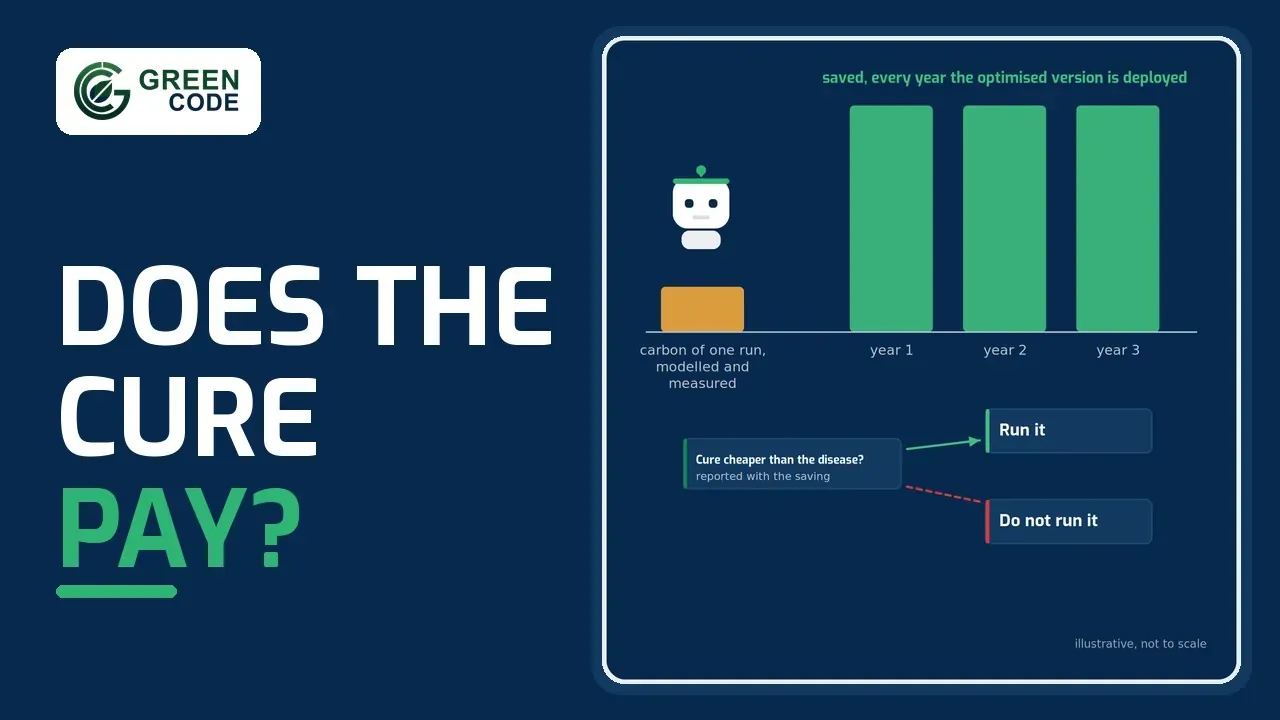
AI is the fastest-growing consumer of energy in the ICT sector, and its demand is still climbing. So any project proposing to use AI to reduce software energy has an obvious obligation: prove the cure costs less than the disease. GreenCode takes that literally. The carbon of the pipeline's own training and inference is modelled, measured and reported alongside the saving it produces. The accounting is simple enough to audit, the reduction repeats every year the optimised version is deployed, and the carbon is spent once. The ratio only holds because the pipeline is engineered to spend as little inference as possible.
That is what energy-efficient AI means in practice, and it is as much about the agentic framework around the model as the model itself. The models are tuned for the narrow task rather than the general one, so a request costs a fraction of what a general-purpose one would spend. A step reads only the fragment of the codebase it needs, not whole files. Work is routed to the lightest step that can do it. And successive runs process only what changed. An agentic framework has to be efficient as well as effective, or the saving it finds is spent finding it.
The second half of energy-aware computing is when the work happens. The same computation on a grid full of wind costs a fraction of the carbon it emits on peaking gas. Because GreenCode analyses a codebase asynchronously rather than interactively, it can hold intensive jobs until clean power is available. Nothing is waiting on the result in the next second, so the latency is free. Copilot-style assistants run inference on every keystroke, wherever the developer happens to be, and optimise the typing. GreenCode optimises the system, in one scheduled pass, with the cost of that run counted.
Scale decides the answer, and it varies enormously. A compact content system installed on hundreds of millions of sites carries a potential saving vastly larger than the run that finds it. So GreenCode runs a pre-assessment before it commits: the lines to be processed, the likely improvement, the size of the deployed base, against the modelled carbon of the run. Where the return does not justify the inference, the honest answer is not to run it. That check applies to GreenCode's own operation as much as to anything it processes. The same methods matter well beyond a code optimisation pipeline. Energy-efficient AI, an agentic framework that is efficient as well as effective, and scheduling against the grid are the techniques that make AI viable at the edge, on battery power, and on constrained hardware, where there is no option to spend more energy. That work transfers directly to anyone trying to run useful AI on limited power. Reach out to us with the AI workload you are trying to fit inside a fixed energy budget, and we will help you understand how GreenCode can get it there.
Benefit film
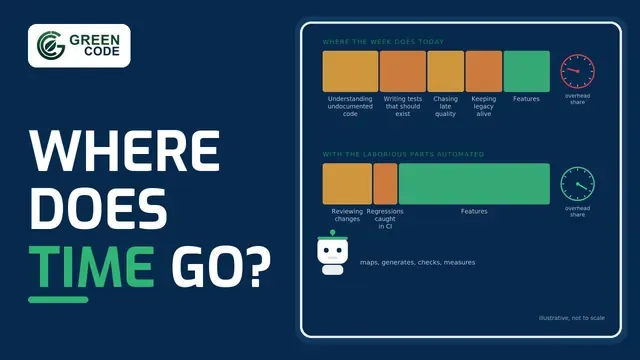
Ask an engineering manager where the team's time goes and the answer is rarely new features.
Benefit film
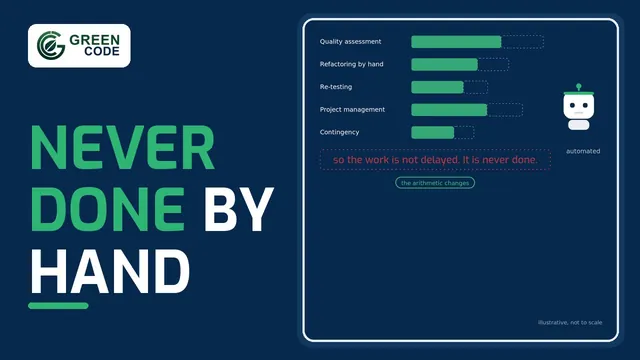
By published estimates, most software in service is legacy, and in banking and healthcare systems written decades ago still carry the transactions and the patient…
Benefit film
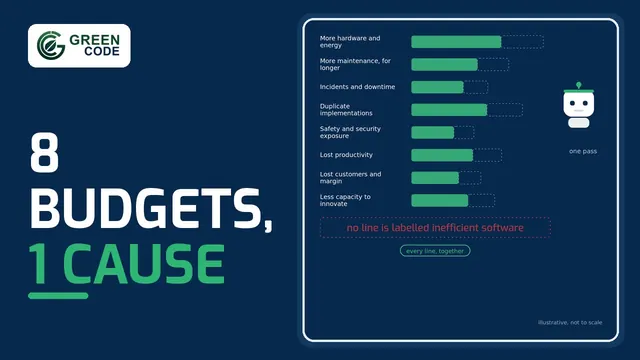
The cost of inefficient software is spread across many budgets, from hosting and energy to incidents, security and lost productivity, so no single line ever shows it.