Ask an engineering manager where the team's time goes and the answer is rarely new features. By the project's own record, in automotive software alone, modernising legacy code is largely manual and takes up to around 40% of developer productivity. This film shows how GreenCode automates the laborious parts, with every generated change checked before a developer sees it.
Read the full page Watch on YouTube
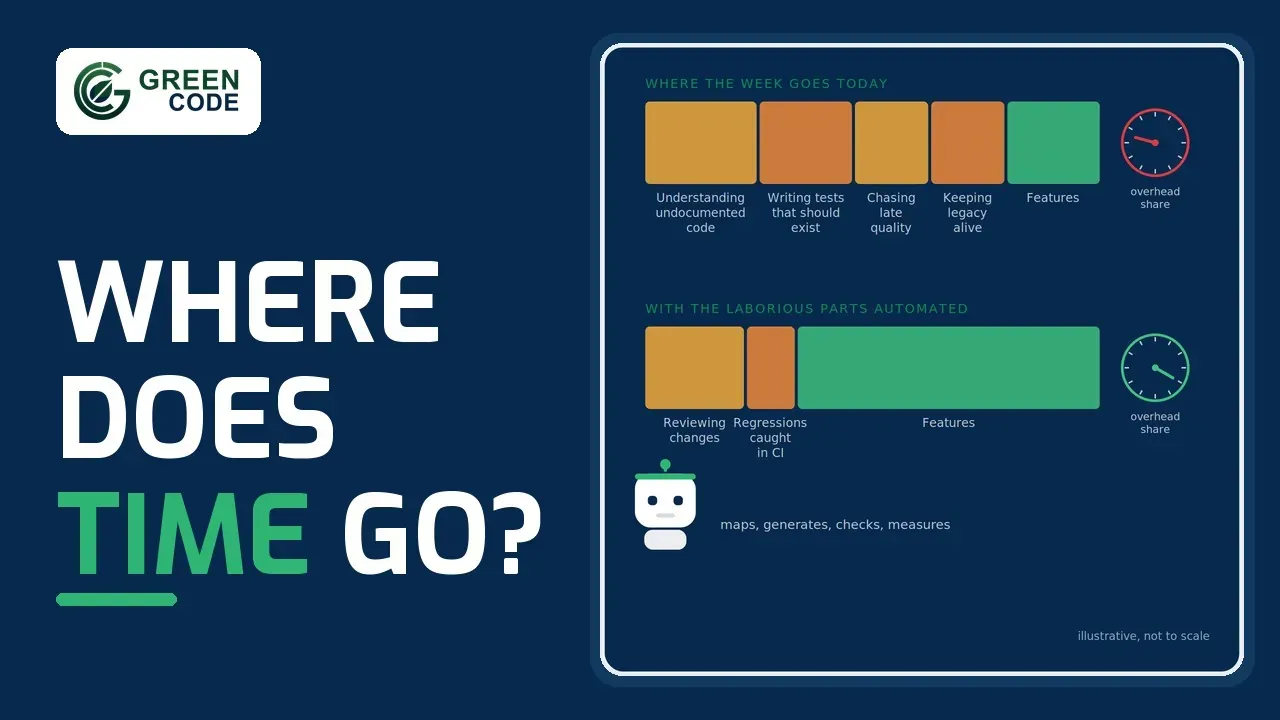
Ask an engineering manager where the team's time goes and the answer is rarely new features. It goes on understanding code nobody documented, writing tests that should already exist, chasing quality faults found late, and keeping legacy systems alive. The consortium names the problem directly: complex maintenance and QA work reduces the productivity of development teams, and the answer is to automate the laborious parts. The productivity case rests on that automation, not on a general claim that AI writes code faster.
The static code analysis work removes the manual steps. Codebase mapping comes first, parsing source in multiple languages into a formal model and giving every later stage a searchable index of the system. Static analysis then treats energy as a quality metric, reporting code smells, security issues and green software patterns together. Artefact generation creates the missing unit tests and documentation a codebase needs before it can be changed safely. The open problems GreenCode targets are doing this at repository level, and linking it to energy regression testing.
Generated changes are then verified. AI-generated code shows only a weak link between functional correctness and quality, and hallucination persists, so GreenCode scores every change against maintainability, security and domain metrics before a developer sees it. The consortium weighs the published productivity figures for copilots against the study showing they can degrade code quality, which is why the checks exist, and holds that GreenCode must lift burdens from developers, not replace them. Energy measurement is a second gap.
There is no widely accepted green developer toolkit; the tools that exist were built for discrete contexts, so teams must stitch them together, and developers see optimisation as extra effort that time pressure pushes out. In most teams it is simply not done. The pipeline automates it: stress testing and benchmarking with energy monitoring, so it can show which change saved what, and output arrives as transparent, reviewable pull requests with a human in the loop. A team gets a mapped, documented and tested codebase without assigning developers to produce it by hand. Energy and quality regressions are caught in continuous integration rather than in production. Reviewers spend their time judging changes, not writing the tests that make them safe. The consortium's estimate of the productivity gain will be tested on partner use cases rather than assumed, including whether running the pipeline live inside the workflow beats batch processing at the end of the day. Reach out to us with the maintenance load your team is carrying, and we will help you understand how much of it GreenCode can automate.
Benefit film
By published estimates, most software in service is legacy, and in banking and healthcare systems written decades ago still carry the transactions and the patient…
Benefit film
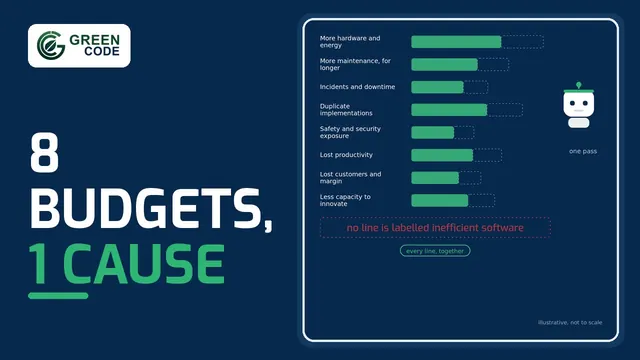
The cost of inefficient software is spread across many budgets, from hosting and energy to incidents, security and lost productivity, so no single line ever shows it.
Benefit film
The ICT sector's emissions are already comparable to aviation's, and they are projected to keep rising.