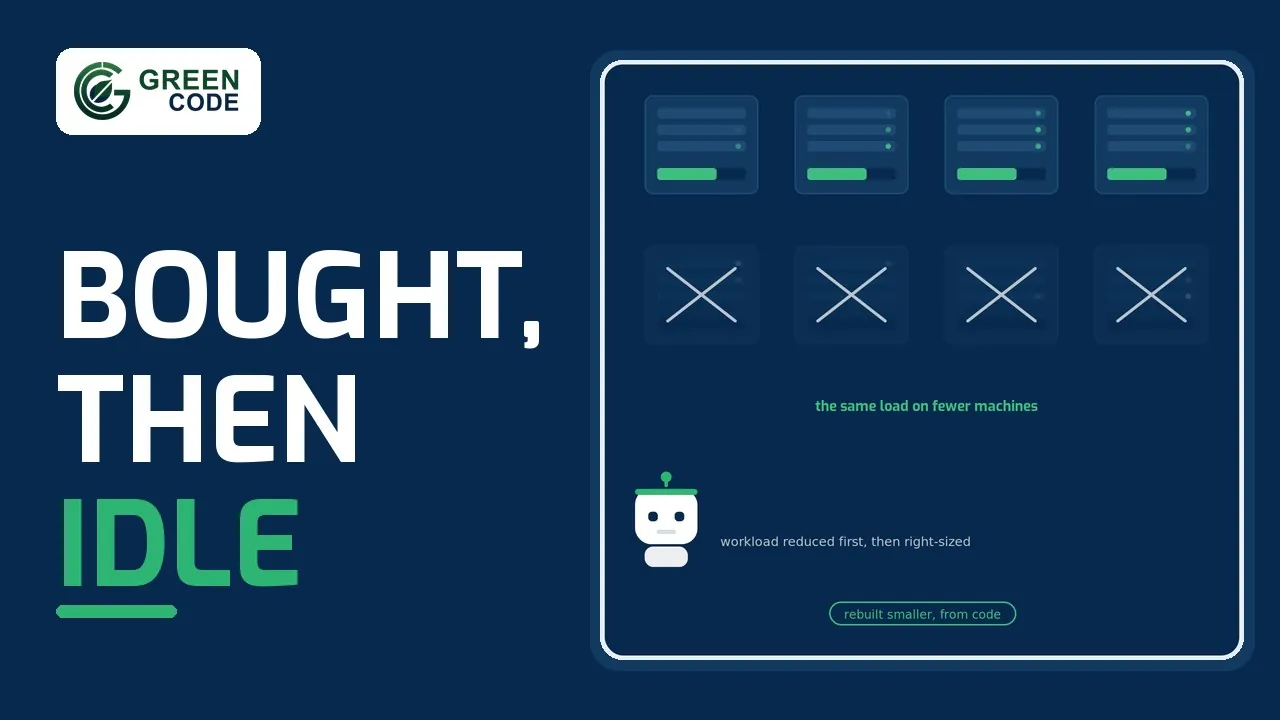
Infrastructure is bought for the moment software demands the most, and by published estimates cloud servers are active only 10 to 30% of the time. This film shows how GreenCode reduces the workload first and then right-sizes what runs it, finding energy hotspots, unused services and needless traffic. Reduce the demand, and cost and emissions shrink with it.
Infrastructure is bought to run software, and the amount is set by what it demands at its worst moment. When code is inefficient, the response is rarely to fix it. It is to add nodes or raise the instance size, and the cost lands on the cloud bill every month after. Servers in data centres are active a fraction of the time and idle for the rest, and as hardware efficiency gains plateau, growing software complexity cancels them out. For a CTO the case is financial before it is environmental: reduce the demand, and the infrastructure, its cost and its emissions shrink together. GreenCode approaches infrastructure from the software side.
Rather than tuning a data centre around fixed demand, it reduces the workload and then right-sizes what runs it, in a loop: measure under load, attribute energy to specific code and components, optimise, and measure again until the improvement stops or a target is met.
The infrastructure part starts with discovery. GreenCode reconstructs a running estate and its dependencies, at the scale of tens of thousands of services. That map is used to find three kinds of waste: energy hotspots, services that are partly or wholly unused and could be shut down or moved to serverless functions, and unnecessary communication between components. The application is then deployed to a reconstructed, instrumented version of its environment and stress-tested, so that code and infrastructure changes are benchmarked in the same controlled setting.
The components sit in the infrastructure work: tools that mine a running deployment and reconstruct a representative environment through infrastructure as code; a toolkit that monitors the energy of the infrastructure and maps it back to application metrics; energy-aware resource management that scales services in line with demand and grid carbon intensity; a recommender that proposes infrastructure changes without loss of performance; predictive models of resource use for database services, a significant hotspot in most estates; and management of jobs across idle or redundant devices, so existing machines are used before new ones are bought. Two partner use cases illustrate it: a research computing cluster with resources often idle and no way to see where its energy goes, and a cloud-hosted system moving to a cloud-native architecture, measured on the provider's bill per customer. The outcome is an estate that is smaller, better understood and easier to rebuild: capacity bought against measured demand rather than a safety margin, unused services switched off, and the infrastructure definition reviewed and versioned like code. These tools are being validated on partner systems now. Reach out to us with the estate you suspect is bigger than it needs to be, and we will help you understand how much smaller GreenCode can make it.
Benefit film
Software defects are an operating cost as well as a delivery problem, and poor code quality can signal weak performance and wasted energy.
Benefit film
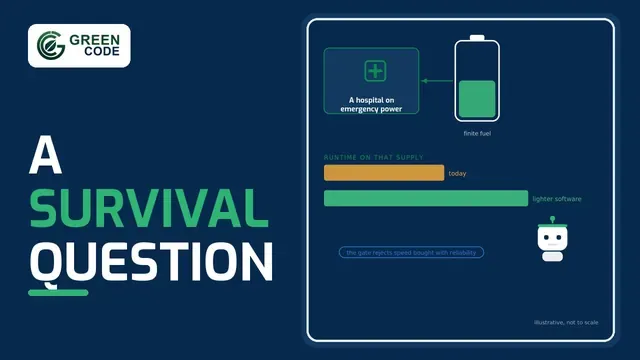
In hospitals, aircraft and electric vehicles, software efficiency is a survival question: a system that draws less power runs longer on whatever reserve is left.
Benefit film
In research computing, a wasteful inner loop is multiplied by every core-hour a job runs, and much scientific software has never been profiled for energy.