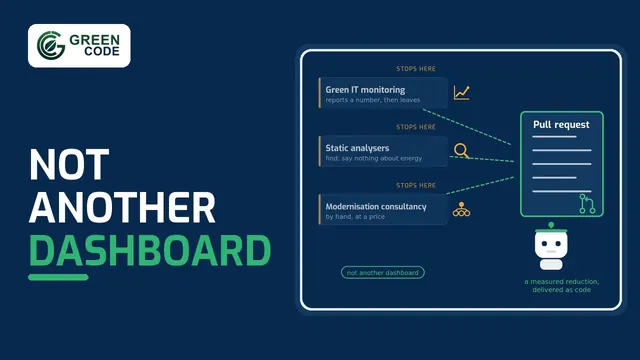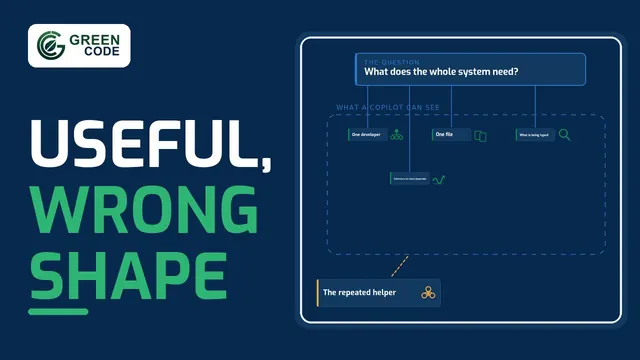
Inefficient software asks for more processing, memory, storage and network traffic than the job needs, and every request becomes both a kilowatt-hour and an invoice. This film shows why that cost hides across eight budgets, and how one automated GreenCode run moves them all in the same direction, as part of maintenance that was going to happen anyway.
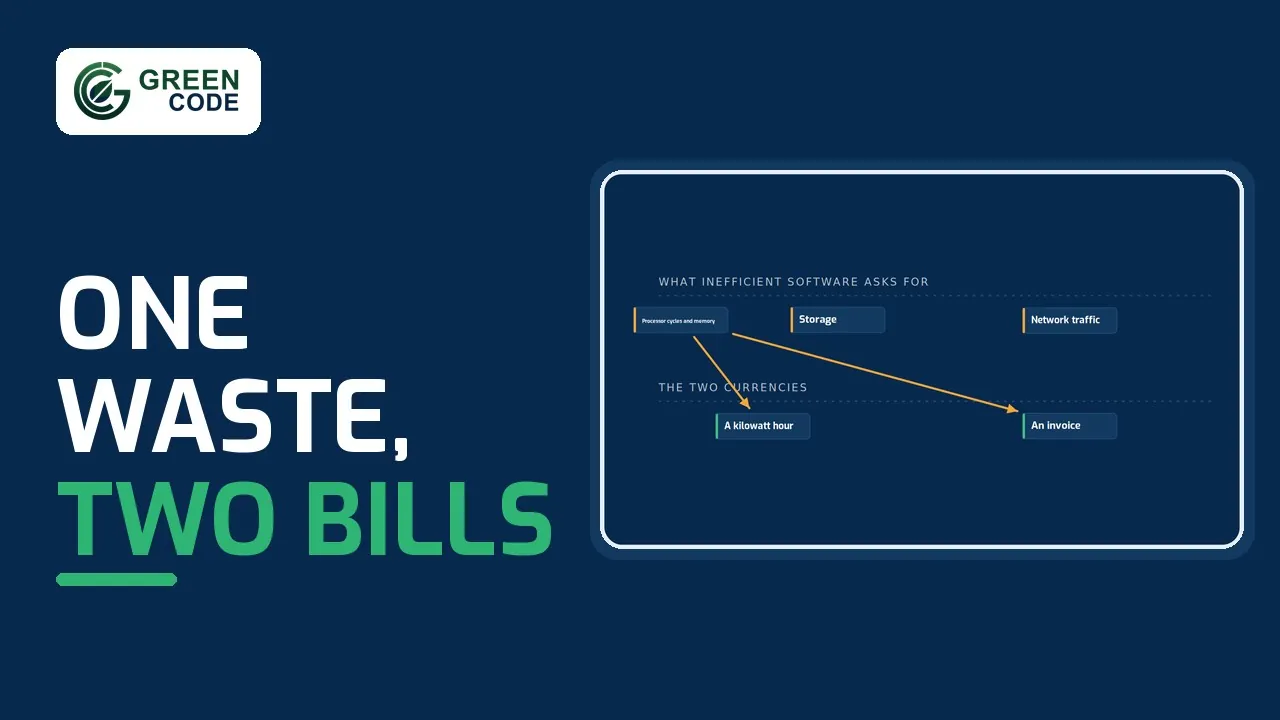
Inefficient software does the same thing whether you look at it as an environmental problem or a financial one. It asks for more processor cycles, memory, storage and network traffic than the job requires, and every one of those requests turns into both a kilowatt hour and an invoice. Energy efficiency and cost efficiency are not two initiatives competing for the same budget. They are one piece of engineering work, described in two currencies. The reason this is not obvious is that the cost never appears under its own name.
Sub-optimal software is paid for on eight budgets: more hardware and energy, more maintenance for longer, incidents and downtime, duplicate implementations, safety and security exposure, lost productivity, lost customers, and a reduced ability to innovate. No ledger has a line called inefficient software, which is exactly why the total is never challenged. Hosting is the clearest case: charges reviewed for discounts rather than for cause, even though the demand that sets them is written into the code. Clearing the debt by hand is the reason it goes on being carried.
GreenCode automates the work an organisation would otherwise pay people to do, and because it is one pass, the returns arrive together. The pipeline maps the codebase and baselines its quality. It refactors the defects, generating the tests and documentation the code was missing. It reconstitutes the infrastructure, benchmarks the system under load, and rewrites the parts responsible for the waste. Then it measures again, with every change returned as a reviewable pull request. One run moves all eight lines in the same direction, and the measurements that prove the saving are the same ones that feed disclosure and the energy rating.
Twenty years ago, checking software for vulnerabilities was specialist consultancy work. Automated security testing turned it into a standing part of the build, and nobody now argues about whether to scan. Tooling of this kind is on the same path for maintenance and decarbonisation. The climate case models what one run is worth for real systems: inference spent once, a saving that repeats every year at every instance. Refactoring purely for efficiency is rarely approved. Refactoring that is automatic, that runs inside the maintenance that was going to happen anyway, and that reduces cost on several lines at once does not need a special business case.
When analysis, refactoring and measurement are automated and repeatable, keeping a codebase efficient stops being a project and becomes a habit, at a cost per run that no manual modernisation programme can approach. Applied to a hosting bill, a hardware refresh cycle and a maintenance budget at once, the reduction is not a rounding error, and it takes effect at the moment of deployment rather than ramping up over years. Reach out to us with the budget line you cannot account for, and we will help you understand how GreenCode can reduce it.
Feature film
A data centre does not consume electricity; the software it runs does, and the building is simply where the meter is.
Feature film
Most software in use today is legacy, and clearing its technical debt by hand can take four engineers most of a year for an ordinary application.
Feature film
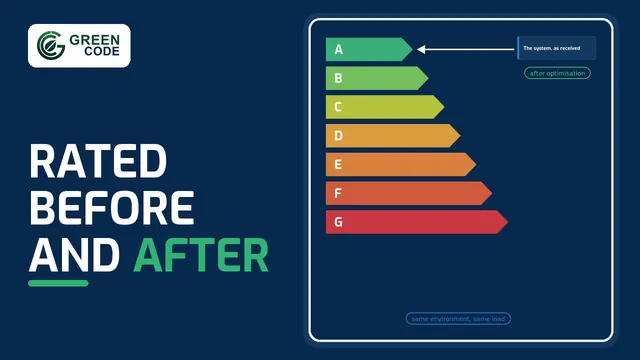
Almost every energy-using product sold in Europe carries a rating anyone can read at a glance; software carries nothing.