Almost every energy-using product sold in Europe carries a rating anyone can read at a glance; software carries nothing. This film shows who would act on an energy rating for software, how the standards to build one are nearly in place, and how GreenCode rates a system before and after optimisation so every claim comes with its evidence.
Almost every energy-using product sold in Europe carries a rating a non-specialist can read at a glance. Software carries nothing. An organisation weighing up two systems can compare licence cost, features and support, and security posture, but not the electricity the software will draw over its service life. That cost arrives later, as a hosting bill, a hardware refresh, or a battery that no longer lasts a shift, and it is written off as part of doing business rather than attributed to the product that caused it.
A rating is only worth building if somebody acts on it. Four groups would. Buyers could compare candidate products on running cost as well as price, and hold a supplier to a stated figure. Tenders could attach a minimum rating to an IT purchase, as public procurement already does for buildings and vehicles. Regulators and auditors could test an environmental claim against a defined method instead of a supplier's own benchmark. And end users could see whether the software inside a phone, a vehicle or a home energy system is frugal with the power it is given. Behind all four is one condition: the measure must be the same everywhere, produced by a method anyone can repeat.
That condition is closer to being met than most people realise. Software Carbon Intensity, the measure developed by the Green Software Foundation, is now an international standard, and it aligns with the corporate carbon inventory standards, so a figure fits inside those accounts rather than beside them. An intensity figure is not yet a grade: the Software Carbon Efficiency Rating turns it into a scale a buyer can act on. The Foundation's patterns catalogue names the changes that would improve it, and the software quality model stops a saving being bought by degrading everything else. GreenCode contributes to that open tooling rather than running a private scheme, because a rating only its author can reproduce is worth very little.
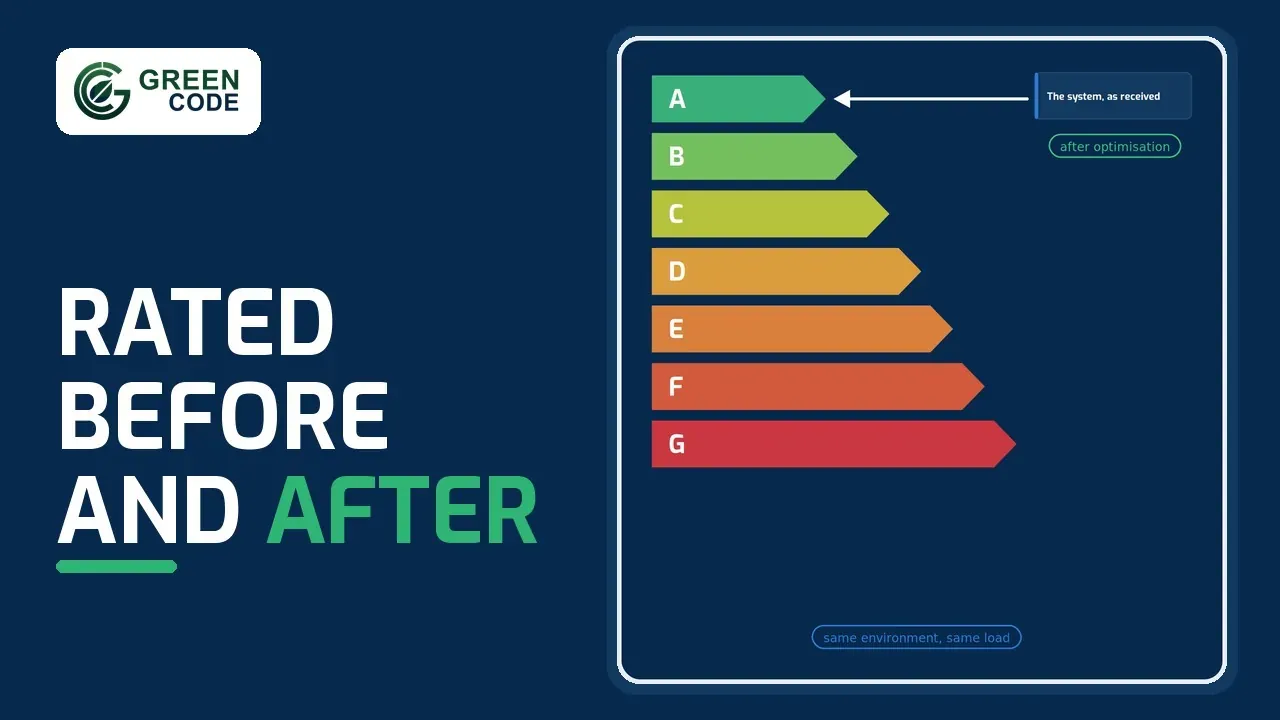
Certification is the final stage of the pipeline, and it measures rather than changes. The system is rated as received, on infrastructure reconstituted from its own configuration, under a defined load. It is rated again after optimisation, in the same environment, under the same load. The gap between the two readings is the claim. The grade travels with its evidence: the measurement boundary, the load profile, the allocation rules, the tool versions, the test results, and the specific changes that produced the reduction. Energy is sometimes measured today, but rarely in a form that can be assured, certified or compared during procurement.
Reporting obligations are widening, and software sits inside them whether or not anyone measures it. Green claims are the sharpest case: an efficiency statement that cannot be substantiated stops being a marketing line and becomes a legal exposure, and a measured, standards-based rating is the kind of proof EU consumer law now expects. A certificate supports disclosure, backs up a claim, and gives procurement something to buy on, which is where a rating starts to change what suppliers build. An organisation that already knows the grade of its estate is in a very different position from one starting from an unmeasured baseline. Reach out to us with the software you need to rate, and we will help you understand how GreenCode can certify it.
Feature film
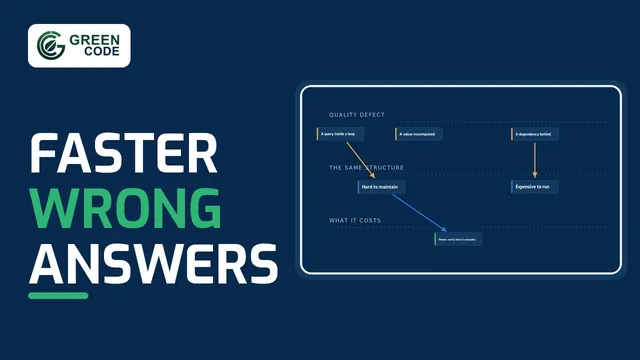
The structures that make software hard to maintain are usually the ones that make it expensive to run.
Feature film
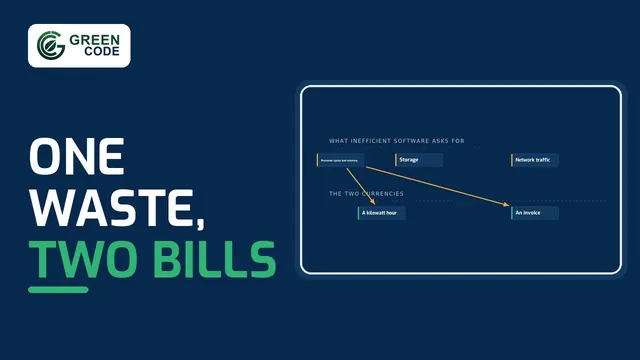
Inefficient software asks for more processing, memory, storage and network traffic than the job needs, and every request becomes both a kilowatt-hour and an invoice.
Feature film
A data centre does not consume electricity; the software it runs does, and the building is simply where the meter is.