A data centre does not consume electricity; the software it runs does, and the building is simply where the meter is. This film explains why monitoring alone does not cut emissions, how GreenCode's five-stage pipeline delivers a measured reduction as code, and why the number of places software runs multiplies every saving.
Before AI and blockchain are added to the account, computing already emits about as much carbon as civil aviation, and most of that is electricity drawn while equipment is running. A data centre does not consume electricity. The software it exists to run does, and the building is simply where the meter is. Data centre operators have attacked cooling, rack density and power purchasing, because the software they host is a black box to them. The same is true of a phone that needs charging by lunchtime, a laptop replaced because a release made it feel slow, and a vehicle whose control systems draw from a battery with other work to do. Every watt in computing is spent executing instructions that somebody wrote.
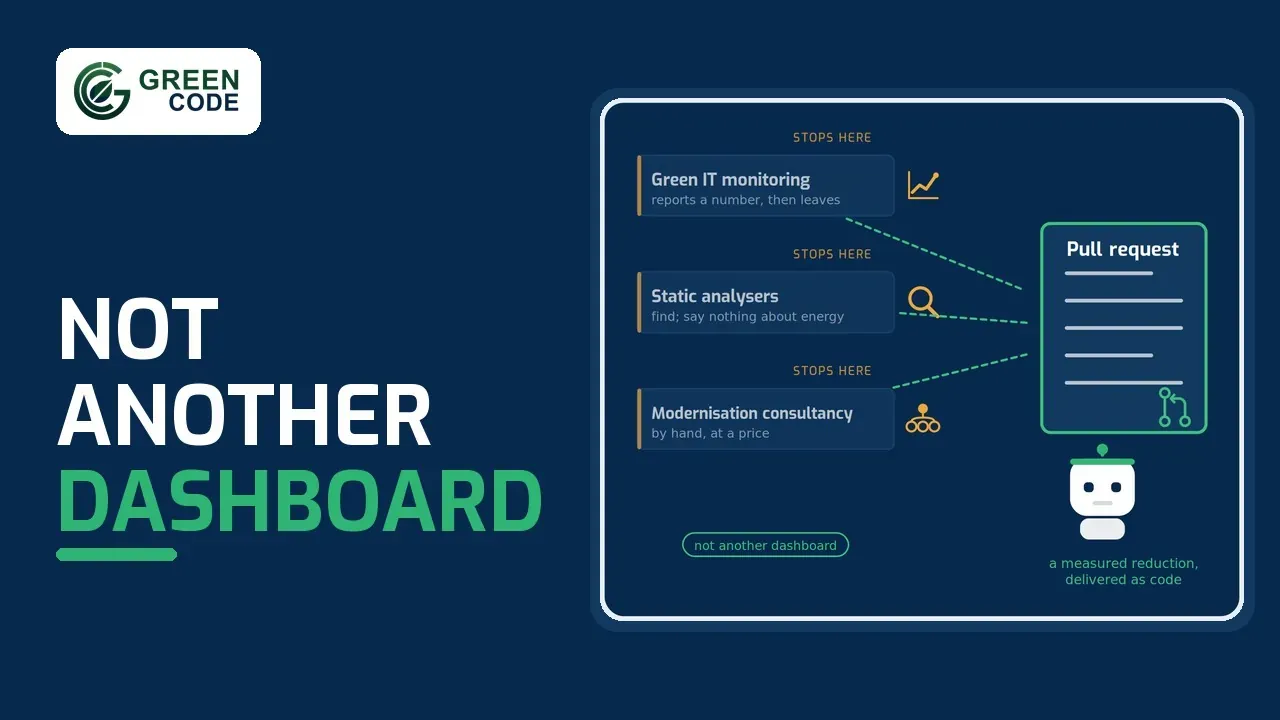
For about seventy years, hardware improvement absorbed whatever software asked for. As Moore's law levels off, that cover is ending, and the waste in software becomes visible on the bill. Green IT monitoring products have multiplied, and they are useful, but they are passive: they report a number and leave a team to work out what to do about it. Static analysers check correctness and security, say nothing about energy, and do not fix what they find. Modernisation consultancies will do the work, by hand, at a price that means only the most valuable systems ever qualify. GreenCode exists to close that gap. The point is not another dashboard. The point is a measured reduction, delivered as code. The consortium is building a pipeline of five stages, each a pluggable component, so tools can be swapped as the field moves.
It maps a codebase into a searchable index with a bill of materials and an inventory of interfaces. It baselines quality and refactors against recognised standards. It reconstitutes a representative deployment environment as infrastructure as code. It benchmarks the system under load while an observability stack records energy against individual code constructs, then rewrites the hotspots and measures again. Finally it rates the result, reports it, and returns every change as a pull request for human review.
Most decarbonisation ramps up over years as assets are replaced. Software does not work that way. An optimised release cuts consumption from the moment it is deployed, at every instance running it, and keeps cutting it until someone undoes the change. That makes install base, not percentage, the number that matters. For a widely deployed database engine, and for the content system that runs nearly half the web, the arithmetic is the same: the run costs a little inference once, and the saving repeats every year, at every site, without a single owner changing anything they do.
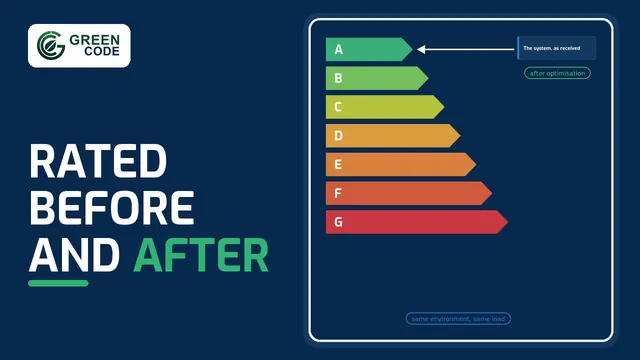
What counts as success is measured, not claimed: a reduction per system large enough to matter, a better carbon efficiency rating, and quality gated at the same time, because a saving bought by breaking something does not qualify. System owners get a lower operating cost and evidence of it. Infrastructure operators get headroom they did not have to build. Developers get the backlog cleared and training drawn from their own code. Procurement gets a rating for a tender, and reporting teams get measured figures rather than estimates. The carbon saving is the same event in every case. Reach out to us with the system you most want to decarbonise, and we will help you understand what GreenCode could save on it.
Feature film
Most software in use today is legacy, and clearing its technical debt by hand can take four engineers most of a year for an ordinary application.
Feature film
Almost every energy-using product sold in Europe carries a rating anyone can read at a glance; software carries nothing.
Feature film
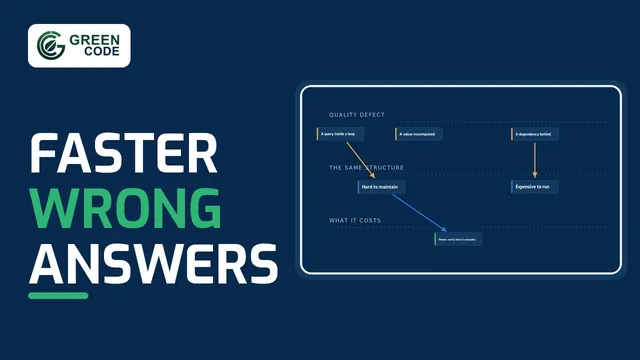
The structures that make software hard to maintain are usually the ones that make it expensive to run.