Most software in use today is legacy, and clearing its technical debt by hand can take four engineers most of a year for an ordinary application. This film explains why a copilot is the wrong shape for that work, and how GreenCode maintains the whole system in the background, with every cycle re-assessed and its own AI kept lean.
Most of the software in use today is legacy. It works, it earns money, and it is held together by people who did not write it. Maintenance on that estate is risky, invisible and unsponsored, so the minimum is done and the rest is carried. What is carried has a cost, and clearing it by hand has a price list: the refactoring, the quality assessment that has to come first, the re-testing, the management on top. For an ordinary application that is four engineers for most of a year, doing work that adds no visible feature. That is why it does not happen. It is not that teams do not know the debt is there. It is that the business case never clears.
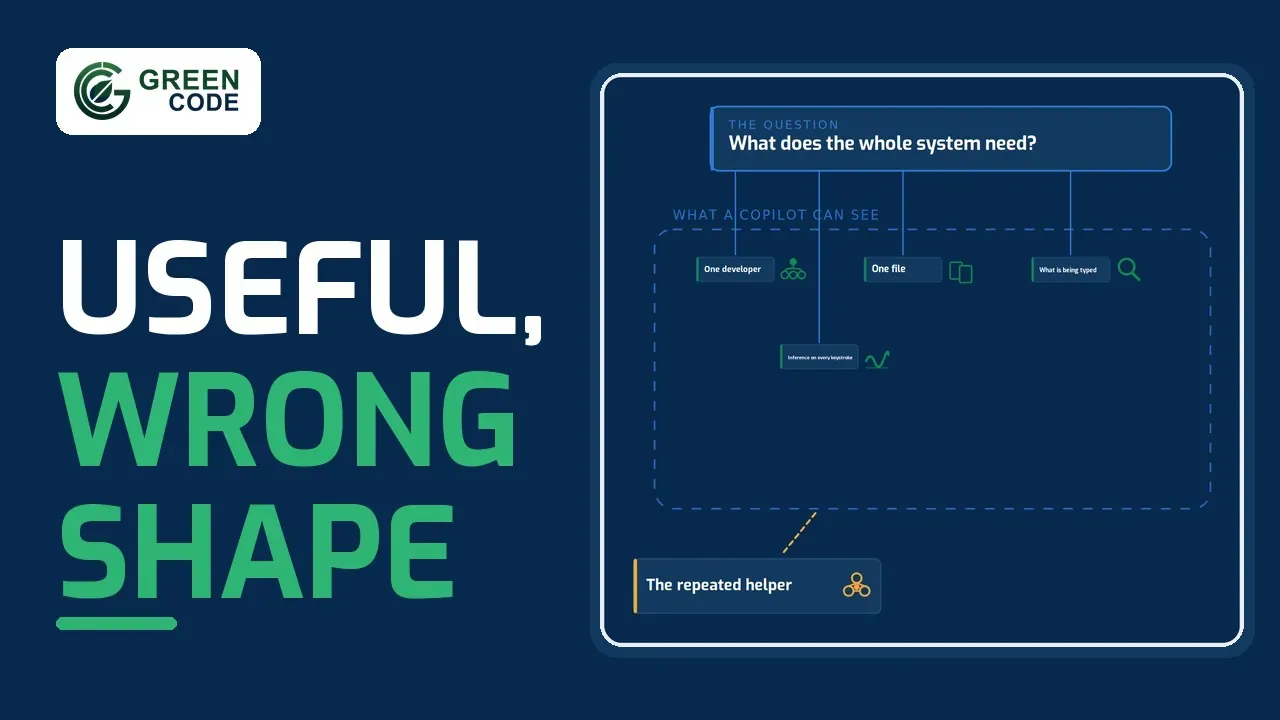
The obvious answer is to point generative AI at the problem, and many teams already have. A copilot sits with one developer, in one file, and completes what they are typing. It is genuinely useful, and it is the wrong shape for maintenance. The question that work has to answer is: what does the whole system need? A copilot can see one developer, one file, what is being typed, with inference on every keystroke. What it cannot see is the helper repeated three hundred times, and the dependency two major versions behind. Those are properties of the system.
GreenCode works on the whole system, asynchronously, and measures as it goes. It maps the codebase first, into a searchable index with a bill of materials. It generates the artefacts the system never had: unit tests, documentation, and commit messages a reviewer can check. It refactors element by element, working through a machine-readable action list, and replaces deprecated or wasteful libraries. It modernises and ports, forms, classes and modules migrated. And it returns everything on an optimisation branch as documented pull requests, so a team reviews rather than inherits. Iteration is bounded and every cycle re-assessed: that gate separates automated maintenance from automated damage.
A tool that uses generative AI to cut consumption has to answer for the energy it spends. GreenCode's approach is energy-efficient AI inside an agentic framework built to be efficient as well as effective: models tuned for the task rather than general ones, reading only what the job needs, routing work to the lightest step that can do it, and processing only what changed between runs. Because the processing is asynchronous rather than interactive, heavy jobs can be held until clean power is on the grid. On the project's own accounting, inference costs a fraction of a percent of what the resulting optimisation saves.
The backlog that was never going to be funded becomes a reviewable set of changes, with the tests, documentation and reasoning attached. The energy saving follows, because cleaner code is cheaper to run, and the energy stage then goes looking for what is left. Reach out to us with the maintenance backlog you cannot fund, and we will help you understand how GreenCode can clear it.
Feature film
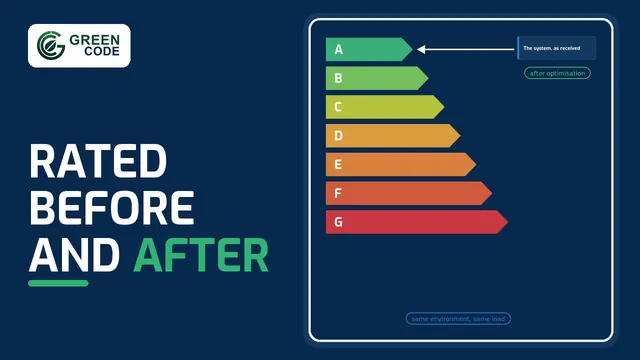
Almost every energy-using product sold in Europe carries a rating anyone can read at a glance; software carries nothing.
Feature film
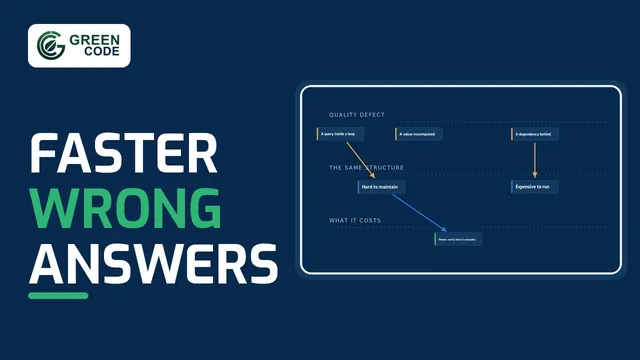
The structures that make software hard to maintain are usually the ones that make it expensive to run.
Feature film
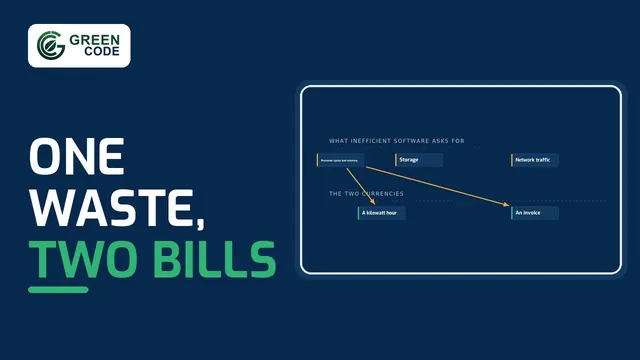
Inefficient software asks for more processing, memory, storage and network traffic than the job needs, and every request becomes both a kilowatt-hour and an invoice.