The structures that make software hard to maintain are usually the ones that make it expensive to run. This film shows how GreenCode assesses quality, security and energy waste together, fixes what it finds in a bounded loop, and checks every generated change rather than trusting it. Quality comes first, because optimising unsound software produces faster wrong answers.
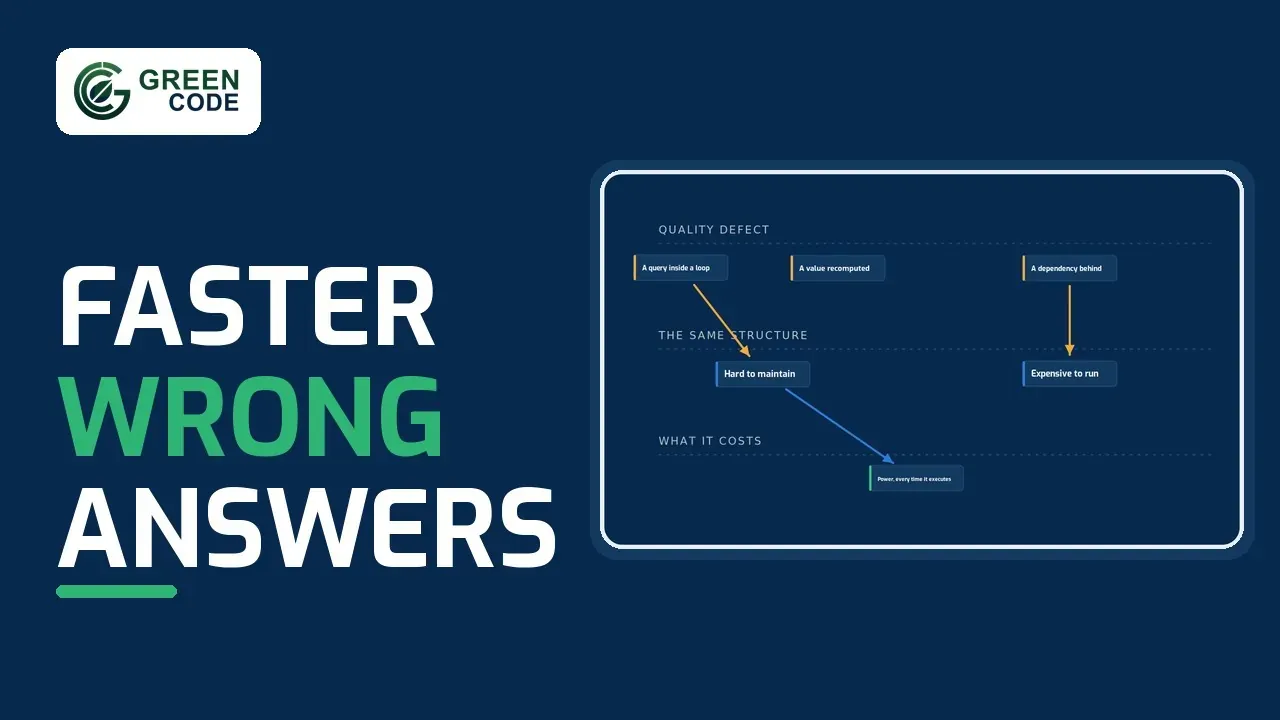
The structures that make software hard to maintain are usually the structures that make it expensive to run. A query issued inside a loop, a value recomputed rather than held, a dependency two major versions behind: each is a quality defect, and each costs power every time the code executes. Ordinary implementation decisions move server energy measurably, and quality work alone delivers a large share of the available saving before anything energy-specific is attempted. That is why GreenCode does quality before energy. Optimising a system that is already unsound produces faster wrong answers.
The analysis scores a codebase against three reference sets in the same pass and treats them as one subject: the quality models, security practice, and the green software patterns, used here as quality metrics rather than advice, so an energy-wasteful construct is recorded as a defect. A missing test, an unvalidated input and a needlessly repeated database call come out of the same analysis, in the same ranked list. A second signal arrives later: when benchmarking records energy against individual code constructs, anything that passes static analysis but draws disproportionate power is treated as defective. These are the sustainability smells: correct, reviewed, and quietly costing a fortune at scale.
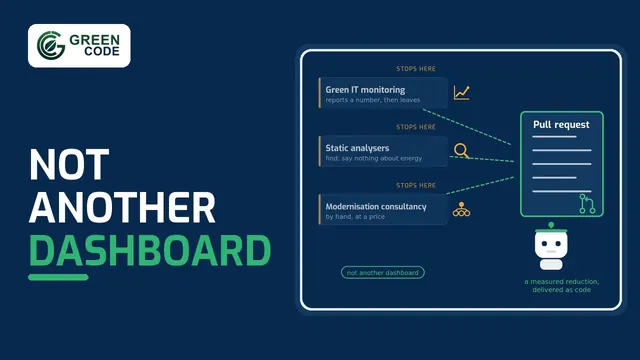
Detection without remediation is where most tooling stops. Monitoring products report and leave; static analysers find and do not fix. GreenCode is built to close the loop. The assessment emits a machine-readable action list, ranked, with the standard behind each finding named. Generative models work through it element by element, rewriting the implicated code, generating the missing tests and documentation, and replacing deficient libraries. The assessment is then re-run against the new version to confirm the uplift actually happened, rather than assuming the model did what it claimed. And iterations are bounded, so the pipeline stops when the gain per cycle no longer justifies the run. Two gates hold the whole thing honest.
The maintainability index must clear its threshold, with cognitive complexity stable or reduced. And the combined count of quality assessment issues, security flaws and error rate must not rise across a cycle. Generated code is held to exactly the same standard as a human's, and is checked rather than trusted: published studies find only a weak correlation between functional correctness and code quality in machine-written software, and the common coding benchmarks ignore energy altogether. That is the failure mode of naive automated refactoring, and it is designed out rather than hoped away.
Four things come back. A ranked list of defects, covering quality, security and energy waste together, with the standard behind each one named. An action plan that says what should change and in what order. The fixed code itself, on an optimisation branch, as documented pull requests that a maintainer approves or rejects. And a report, readable by someone who does not write code, showing what the re-assessment measured after the changes were made. Once this baseline holds, the pipeline moves on to the energy work. Reach out to us with the codebase you are least confident in, and we will help you understand how GreenCode can put it right.
Feature film
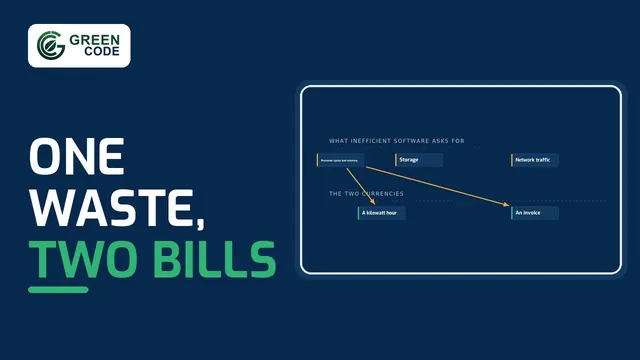
Inefficient software asks for more processing, memory, storage and network traffic than the job needs, and every request becomes both a kilowatt-hour and an invoice.
Feature film
A data centre does not consume electricity; the software it runs does, and the building is simply where the meter is.
Feature film
Most software in use today is legacy, and clearing its technical debt by hand can take four engineers most of a year for an ordinary application.